Article summary: As many in the industry reflect on the state of the tailings management talent pipeline, our recent survey sheds light on both the pressures practitioners are facing and the opportunities emerging across the profession. Respondents shared candid perspectives on the factors influencing how tailings teams develop, collaborate, and advance. In this article, we explore what their insights reveal and how they can help guide a stronger, more resilient path forward for tailings management professionals.
Across the mining industry, the tailings management talent pipeline has become a topic of growing concern. We have heard the buzz at conferences, from our clients, within professional societies, and across our own organization: senior expertise is retiring quickly, new regulations and standards are expanding technical demands, and teams feel stretched thin.
We wanted to know: What’s really happening across the profession? Are these concerns universally felt? Or do perceptions differ depending on where people sit in their careers?
To find out, we conducted an industry-wide survey of more than 130 practitioners—from junior engineers to senior technical leaders across major mining regions. The anonymous survey was distributed broadly to consulting firms, mine owners, and academic institutions. The results confirmed many of the challenges people have been sensing while also revealing clear opportunities to improve the talent pipeline.
Primary region of professional practice and experience of survey respondents
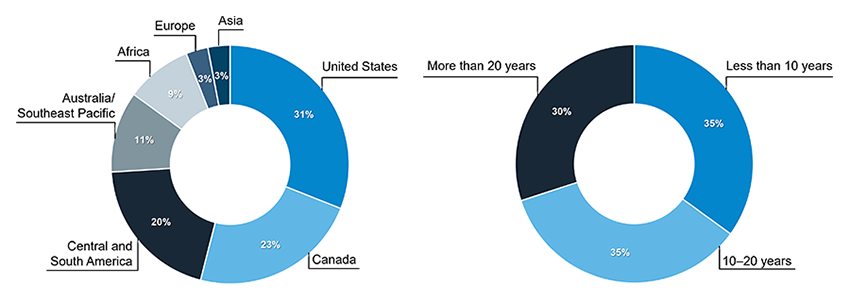
Here, we summarize those insights and offer practical steps organizations can take to support the next generation of tailings professionals.
Workload pressures are widespread—and growing
Workload isn’t just affecting project delivery—it’s affecting how we train and sustain the next generation.
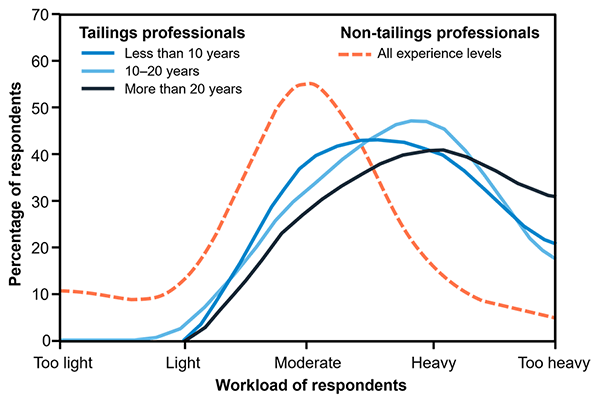
One of the clearest messages from the survey is that tailings professionals are carrying heavier workloads than many of their peers in other engineering disciplines. Mid-career and senior practitioners, in particular, described workloads that leave little time for mentoring or coaching junior staff—activities that are essential for building the next generation of tailings expertise.
This strain is especially concerning in a field where regulatory expectations, technical rigor, and operational risks are continually increasing. As workloads rise, the profession’s ability to transfer knowledge and support succession planning becomes even more constrained.
Workload of tailings vs. non-tailings professionals
A pipeline under strain at every stage
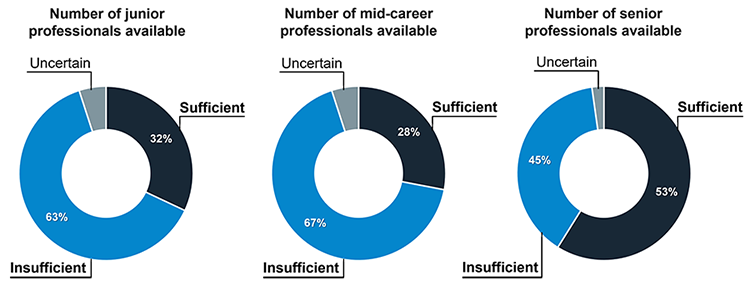
We also asked respondents whether their organizations have enough professionals to staff current and anticipated tailings projects. The answer was striking:
- Two-thirds of respondents report insufficient staffing at junior and mid-career levels.
- Nearly half report shortages even at senior levels.
These gaps create a compounding effect: reduced availability at early-career levels means fewer people gaining exposure to the types of work that produce strong mid‑career practitioners. Limited mid‑career capacity, in turn, limits the development of future Engineers of Record (EORs) and technical leaders.
Availability to staff current and anticipated tailings projects
Impacts on project delivery and growth
The talent pipeline issue is no longer a future risk—it’s affecting project delivery today.
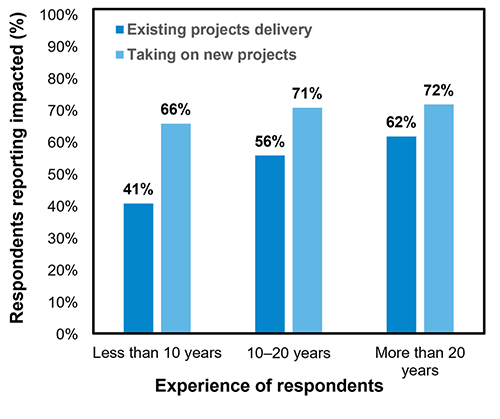
As expected, the staffing gaps have very real consequences. Many respondents reported that shortages are affecting project schedules, limiting opportunities to pursue new work, and adding pressure to teams already operating at high capacity. Between 40 and 60 percent of respondents cited impacts on schedule, quality, and/or delivery of existing projects.
This finding reinforces a key insight: the talent pipeline is not simply a human resources concern. It is a strategic risk directly tied to project outcomes and the industry’s capability to meet growing operational and regulatory expectations.
Projects impacted by staffing shortages
Succession planning: Unclear and inconsistent
The step from practitioner to EOR feels unclear—and at times, inaccessible.
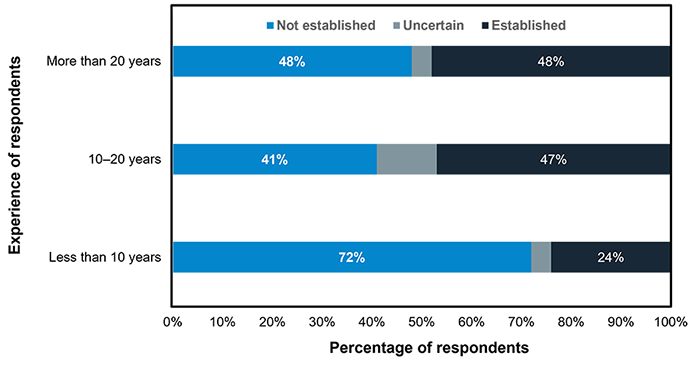
Despite the pressures described above, succession planning—especially for EOR and other senior technical roles—remains inconsistent. Early-career respondents overwhelmingly noted that they are not aware of clear succession plans within their organizations. And while mid-career and senior professionals were more likely to say succession plans exist, fewer than half reported them as clearly defined.
This mismatch suggests that even when planning is happening, it may be informal, inconsistent, and beyond the reach of those who most need it. Clarifying this journey, and making it more intentional, may be one of the most impactful steps organizations can take to strengthen the next generation of tailings professionals.
Perceptions of succession planning by experience level
How tailings professionals learn and grow
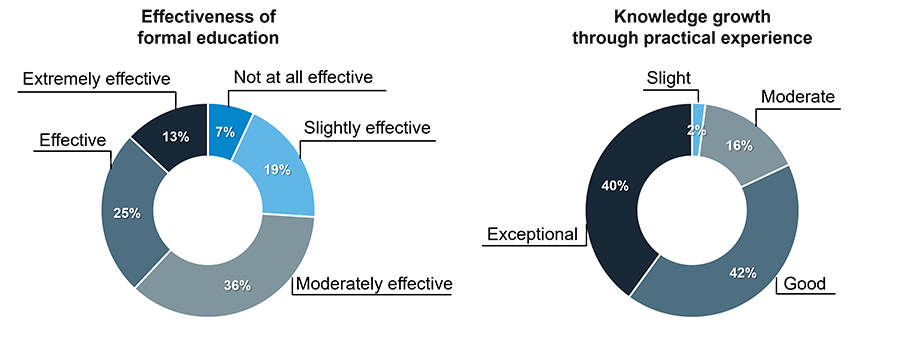
Another strong message from the survey is that tailings expertise is built primarily through practice. Respondents generally felt that formal education provides a foundation, but most learning occurs once professionals enter the field through on-site project experience, office-based analytical work, and mentorship from more experienced colleagues. Short courses and workshops play an important supplementary role but are most effective when paired with real project exposure.
This reinforces the importance of creating opportunities for well-rounded development, especially for early-career engineers who rely heavily on project diversity, mentorship, and structured learning pathways.
Comparison of knowledge-development methods
What’s holding professionals back?
When we asked respondents to identify barriers to professional growth, their answers were remarkably consistent across experience levels. Top concerns included:
- Lack of clear organizational frameworks for professional development
- Inconsistent access to coaching and mentorship
- Difficulty navigating field and office responsibilities
- Gaps in collaboration across project teams
For mid-career and senior professionals, an additional barrier emerged: the weight of personal responsibility and liability. Together, these barriers point toward the importance of structure and forethought in how organizations support their teams.
The unique appeal of building a career in tailings
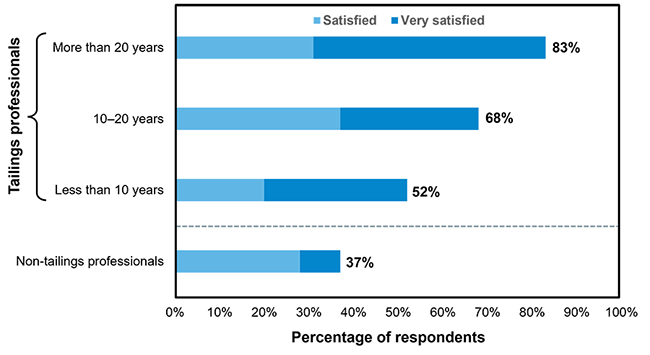
Despite the challenges highlighted in the survey, respondents also expressed deep appreciation for what makes tailings work rewarding. Many described the intellectual challenge of working with complex and multidisciplinary systems, continuous learning opportunities in an evolving field, the satisfaction of contributing to projects that protect people and the environment, and the opportunity to collaborate across disciplines and geographies.
For early-career professionals and students exploring the field, these perspectives are powerful. This feedback shows that, while the work is demanding, it offers purpose, variety, and technical challenges that are difficult to find in any other discipline.
Career satisfaction by career level
Advancing the talent pipeline, together
“A career in the tailings field offers a unique intersection of technical challenge, responsibility, and purpose. Every project involves complex geotechnical and hydrological systems that require deep critical thinking, multidisciplinary collaboration, and long-term stewardship.” —Survey respondent
Taken together, the survey findings point to several clear opportunities to strengthen the talent pipeline and support the long-term health of the tailings management profession. Respondents emphasized the need for clearer pathways from junior roles to becoming an EOR, improved access to mentorship, and more balanced project exposure across field and office tasks. They also underscored the importance of recognizing the critical value of tailings work and ensuring that organizational structures and resourcing reflect that significance.
These insights reinforce something we strive for at Barr: sustaining excellence in tailings engineering requires continuous investment in people’s careers. We’ve been building on this through initiatives that support technical growth and career progression, including our coaching and mentorship programs; individual education accounts for continued learning; industry conference, committee, and professional organization involvement; and an active tailings management practice group that fosters knowledge sharing and collaboration across teams. Together, these efforts help our professionals deepen their expertise, navigate evolving responsibilities, and stay engaged in the work that matters most.
Strengthening foundations like these, across the industry, will not only help retain and develop current professionals but also attract the next generation of engineers who will carry this essential work forward. If these findings resonate with challenges you’re seeing in your own organization, connect with our team to explore how we can support your projects, your people, and your long-term facility needs.
Insights presented at MINEXCHANGE 2026
We shared the full survey results—and dug deeper into how perceptions differ across experience levels—during our session, “Next Generation of Tailings Professionals,” at MINEXCHANGE 2026. Download a PDF of the presentation at the end of this article.
About the authors
Md Fyaz Sadiq, geotechnical engineer, supports mining and power sector clients with tailings management, mine waste, and coal ash projects. His experience includes geotechnical characterization of tailings and geomaterials; slope stability and seepage analyses; instrumentation planning and performance monitoring; and design evaluations for tailings storage facilities. In addition to his consulting work, Fyaz has published research on geomaterial behavior, soil stabilization, freeze-thaw resilience, drainage performance in wet-freeze climates, and the integration of AI tools into geotechnical workflows. He serves on the ISSMGE Technical Committee on Frost Geotechnics and the ASCE Geosynthetics Committee.
Katie Zadrozny, senior geotechnical engineer, has more than a decade of experience across various aspects of tailings management, including shallow and deep foundation design, slope stability and embankment analysis, and infrastructure advocacy. Her expertise includes in-situ testing, soil design parameter modeling, and seepage analysis. She has managed geotechnical aspects of tailings storage facilities and provided technical project support for public and private critical facilities throughout the U.S. This variation in project nature and geologic setting has exposed her to design practices in deep soft soils, shallow bedrock, expansive soils and bedrock, and seismic conditions.
Jason Harvey, senior geotechnical engineer, has performed extensive work related to tailings management for mining clients in North America and internationally. His work has focused on in situ and advanced laboratory testing for the geotechnical characterization of mine tailings; analysis and design of tailings storage facilities; and performance monitoring and evaluations in support of ongoing tailings storage facility construction and operations. He has also performed dam safety reviews and contributed to independent third-party reviews of tailings storage facilities. In addition, Jason has performed geotechnical investigation, design, and construction services for seepage cutoff walls and remediation of hydroelectric dams.
Kurt Schimpke, vice president and senior geotechnical engineer, provides tailings and coal ash management services to mining and power sector clients. He performs alternative studies and develops storage facility designs. He also manages geotechnical investigations and instrumentation systems used to monitor dam performance, develops long-range plans, and assists with environmental permitting. Kurt regularly performs dam safety inspections and oversees development of integrated data management systems for instrumentation monitoring and site surveillance data. He has been involved in projects across Minnesota, Canada, and the Middle East. In addition, he serves on the organizing committee for the Tailings and Mine Waste Conference and is a past president of the Minnesota Geotechnical Society.
Aaron Grosser, vice president and senior geotechnical engineer, has 30 years of experience providing services related to the design and operation of tailings storage facilities, earth dams, flood control structures, and slope stabilization for facilities in North and South America.
Tailings expertise at work: Project highlights
Tailings facility dam safety review
Barr completed an independent dam safety review (DSR) for one of Suncor Energy Inc.’s oil sands external tailings facilities, classified as an extreme‑consequence facility. The review assessed the safety and performance of the containment system, including design, operation, and external risk factors. Barr also evaluated the facility’s safety management systems and identified opportunities to strengthen ongoing dam‑safety practices. The final DSR, conducted in compliance with regulatory requirements and CDA guidelines, provided Suncor with a clear understanding of current conditions and potential next steps.
Closure planning and design for tailings storage facility
Barr supported a mining client in developing a risk‑informed closure plan for a legacy tailings storage facility approaching regulatory decommissioning. Our team developed several closure design options, modeled closure scenarios, and helped identify a sustainable approach for managing residual wastes. We then advanced the work into detailed engineering and design, including an impervious cover design, landform planning, and targeted investigations to guide safe, long‑term closure. This comprehensive approach led to regulatory approval, with construction expected to begin in 2026.