Better models, better decisions: Advancing tailings dam breach analysis with HEC-RAS
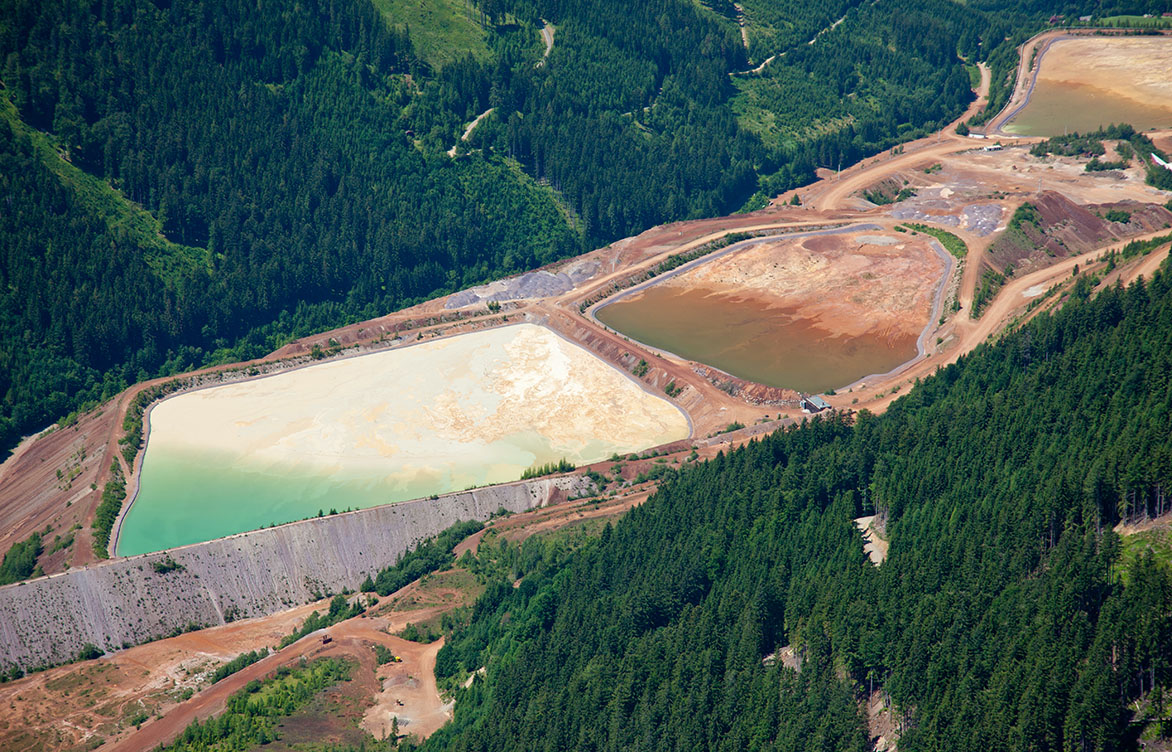
Article summary: Tailings dam breach analysis helps mine owners understand and prepare for the potential consequences of tailings dam failures. As guidance and industry expectations continue to evolve, the need for transparent and practical modeling approaches is growing. This article explores how Barr is advancing the use of HEC-RAS to better represent the behavior of tailings-water mixtures, supporting effective consequence assessments, emergency preparedness, and long-term decision-making.
As the mining industry prepares for Tailings and Mine Waste 2026, tailings dam breach analysis (TDBA) remains a central focus for mine owners, regulators, and engineers alike. Responding to historical tailings-dam failures around the world, expanding guidance from organizations such as the Canadian Dam Association (CDA) and the Global Industry Standard on Tailings Management (GISTM) has underscored the importance of understanding potential consequences—for people, infrastructure, the environment, and cultural resources—before a failure occurs and using that information for preparedness and risk management.
Today, a TDBA does far more than satisfy regulatory expectations. It supports emergency planning and long-term decision-making. Barr is helping advance the practice to deliver TDBA results and tools that are not only technically defensible but also transparent, practical, and valuable throughout the life of a tailings facility. A recent study explores how strategic application of the Hydrologic Engineering Center’s River Analysis System (HEC-RAS), publicly available hydraulic modeling software from the U.S. Army Corps of Engineers (USACE), can help achieve that goal while addressing the unique challenges of modeling tailings-dam breaches.
What makes tailings dam breaches challenging to model
A TDBA centers on a model that simulates how tailings released from a dam would move through a landscape. To provide useful information about the risk and potential consequences of a breach, that model needs to represent a tailings facility as closely as possible. But modeling mine tailings is more complicated than predicting where water will flow.
Most conventional flood models simulate clear water. Tailings, by contrast, are often dense, hyperconcentrated mixtures whose properties change over time and distance. As released tailings flow downstream, new material may be added to the mixture through erosion, or downstream water bodies may dilute the mixture. These effects change the mixture’s composition, including its viscosity, yield stress, and mobility. In other words, the material we’re modeling may not behave the same way a few kilometers downstream as it did when it left its source.
A TDBA also requires answering several interconnected questions:
- How much tailings and water could be released?
- How quickly would a breach form?
- How much material could liquefy?
- How would changing sediment concentrations affect flow behavior?
- And how would local topography, rivers, lakes, and downstream infrastructure influence the path and severity of the flow?
Each assumption influences the next, creating uncertainty that can significantly affect the results.
Eliminating uncertainty is not the goal, nor is it realistic. The goal of a TDBA is to understand and bracket uncertainty by identifying a range of credible breach scenarios and developing a defensible picture of potential consequences. This enables mine owners to make informed preparedness and risk-management decisions.
HEC-RAS: A tool with great potential
As TDBAs become more visible, we’re paying closer attention to the modeling tools behind them and the value they provide.
HEC-RAS models can be shared with clients, regulators, independent reviewers, and future consultants without licensing barriers or software-specific restrictions.
Historically, many TDBAs have relied on proprietary software. While those tools remain widely used, they can create challenges for model transparency, transferability, independent review, and long-term ownership. HEC-RAS offers a different approach. Because the software is publicly available, HEC-RAS models can be shared with clients, regulators, independent reviewers, and future consultants without licensing barriers or software-specific restrictions.
For mine owners, this creates value beyond a single TDBA. Breach models often need to be revisited during dam safety reviews, updated when facilities expand, or examined by third-party reviewers. An open and widely supported platform helps ensure that important analyses remain accessible and useful throughout the life of a tailings facility.
HEC-RAS is developed and maintained by the USACE, providing a robust development framework, extensive documentation, and ongoing technical improvements. But HEC-RAS on its own isn’t an answer. Like all modeling tools, it has limitations of its own, and it’s important to understand those limitations deeply and apply the tool appropriately to the unique challenges of modeling tailings-water mixtures.
Refining HEC-RAS models for TDBA
Barr’s TDBA practitioners are advancing the use of HEC-RAS to deliver greater value for mine owners. We’ll present a recent study at Tailings and Mine Waste 2026, which will accompany a paper in the conference proceedings.
For an anonymized upstream-raised tailings storage facility, we developed a three-stage HEC-RAS workflow designed to better represent how tailings mixtures evolve as they move downstream. The approach combines detailed near-field analysis, where changes in sediment concentration are most important, with efficient far-field routing that remains practical for consequence assessments of large, complex facilities.
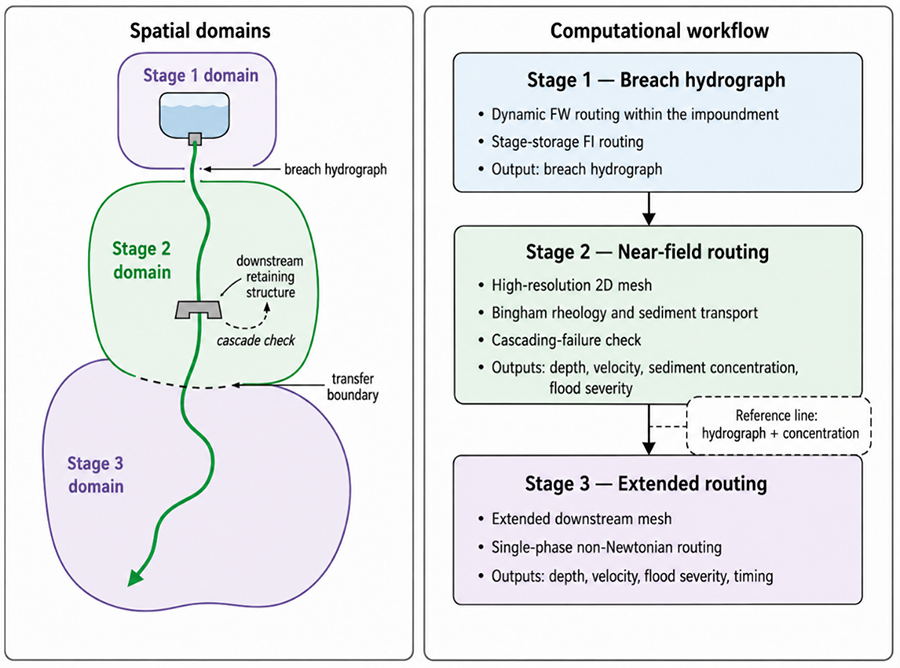
The workflow also emphasizes clarity and transparency in the estimation of release volume by separately evaluating the contributions of individual tailings components: liquefied tailings, pond water, eroded tailings, and embankment materials. This helps practitioners better understand which components are driving downstream consequences and provides a clearer basis for evaluating uncertainty.
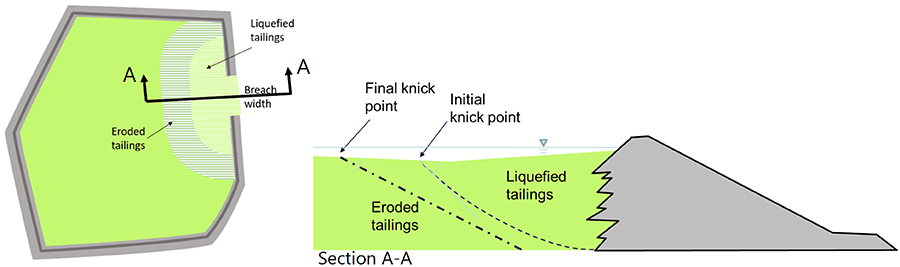
Our study shows that HEC-RAS can be adapted to address challenges historically viewed as limitations of the software, particularly when modeling concentration-dependent behavior and downstream mixing. For TDBA practitioners, it offers a repeatable approach for producing a reliable and transparent dam-breach model. For mine owners, it offers an opportunity to maintain a functional model of their tailings dam facility that is easily shared, updated, and applied.
Better models support better decisions
Ultimately, the value of a breach assessment is not the model itself. It is the decisions the model supports.
Model outputs help mine operators and regulators evaluate inundation extent, flood arrival times, flood severity, and potential downstream impacts. These insights directly support emergency preparedness planning and help organizations understand a range of failure mechanisms and their potential consequences.
The most severe consequence scenario is not always the most obvious one.
One of our findings illustrates this point well: In this study, the scenario with the greatest consequences was not the scenario with the largest storm. Instead, consequence severity was strongly influenced by the volume of tailings released, the flow pathways, and the locations of downstream receiving water bodies.
For mine owners, that distinction matters. The most severe consequence scenario is not always the most obvious one, which is why defensible consequence assessments require more than simply evaluating peak flows or extreme weather conditions.
Onward from here
The mining industry continues to learn from historical failures, emerging guidance, and ongoing research. Important challenges remain in areas such as rheological characterization, uncertainty analysis, model validation, and consequence assessment.
Barr’s TDBA practitioners are actively evaluating, testing, and improving the use of modeling tools. Through research, publications, participation in technical committees, and collaboration with industry and academic partners, we’re committed to the continued refinement of tailings dam breach analysis.
The objective is not simply to build more sophisticated models. It is to make TDBAs more transparent, more practical, more transferable, and ultimately more useful for mine owners working to understand risk and strengthen emergency preparedness. Contact us to learn more.
Attending Tailings and Mine Waste 2026?
Meet us in Westminster, Colorado, November 8–11, 2026, for Tailings and Mine Waste 2026. Join Barr’s mine-tailings experts to learn how advances in TDBA methods are helping make consequence assessments more transparent, defensible, and useful for long-term risk management and emergency preparedness. Come visit Barr at Booth #11.
Want to know more about our work with HEC-RAS? Visit Poster Session P1.1 in Meadowbrook on Monday, November 9, 2026, from 10:30 a.m.–12:00 p.m., when we’ll present our digital poster, “Tailings Dam Breach Analysis of an Upstream-Raised Tailings Storage Facility: A Case Study Using a Three-Stage HEC-RAS Modeling Framework.”
About the authors
Hossein Kheirkhah Gildeh is a senior water resources/hydrotechnical engineer and project manager specializing in tailings dam breach analysis, flood-inundation mapping, and consequence assessment. He leads and models dam breach studies for mining and power clients—reviewing background data; assessing plausible failure modes; developing breach scenarios and parameters; creating outflow hydrographs; and routing releases with hydraulic models to produce inundation maps aligned with industry guidance. He has performed TDBAs for confidential mining clients in Canada, the U.S., Chile, Mexico, Argentina, Zambia, and Burkina Faso. He also serves on the Canadian Dam Association’s Tailings Dam Breach Analysis committee and has published journal and conference papers on TDBA topics.
Kinda Chakas is a water resources specialist who performs hydrologic and hydraulic modeling for dam breach, flood-risk, and facility-resilience studies. Her experience includes modeling potential breach scenarios to inform flood-mitigation measures; conducting HEC‑RAS 2D rain‑on‑grid and scour analyses and developing flood‑inundation mapping; and HEC‑RAS stream‑diversion modeling and hydrologic/hydraulic design for mine feasibility studies. She applies tools such as HEC‑HMS, HEC‑RAS, HydroCAD, and EFDC+, with strong computational skills in Python and MATLAB.
Art Kalmes is a vice president and senior civil engineer with four decades of experience in civil and water resources engineering. He specializes in tailings management, dams and levees, water management, and civil engineering design. He has served as principal or project manager for dozens of large industrial and mining projects for tailings containment and infrastructure improvements. Art has directed studies for mining clients on five continents. These studies range in scope from concept studies to final design and construction. He serves as the Engineer of Record (EOR) for tailings storage facilities at four mine sites and has served as an independent technical reviewer.