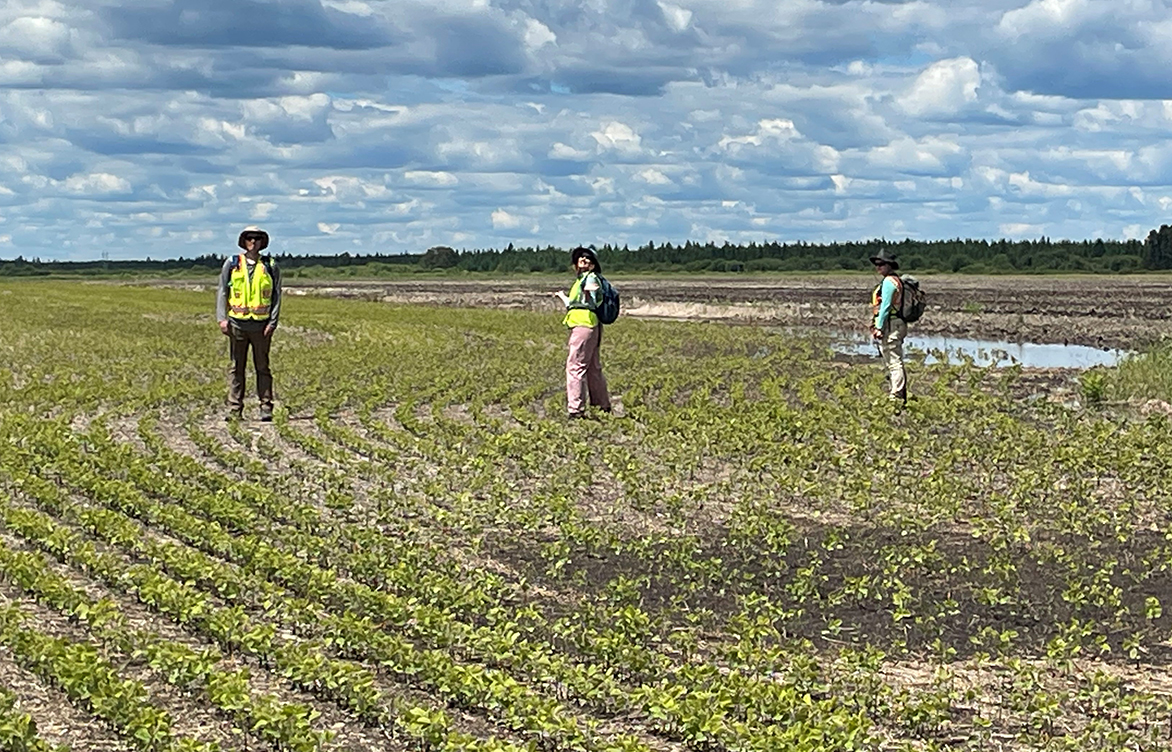
 Archaeology interns Isaiah Gardell and Jessie Johnson work alongside a Barr colleague during a cultural resources survey for a proposed solar energy project in northern Minnesota.
Article summary: For archaeology interns Jessie Johnson and Isaiah Gardell, a summer project in northern Minnesota became more than a chance to conduct fieldwork—it was an opportunity to gain a deeper understanding of cultural resources work and its role in preserving history. Working together on a cultural resources survey for a proposed solar energy project, the pair gained hands-on field experience, collaborated across offices and disciplines, and learned how projects move from planning to final report.
When many people think of archaeology, they picture excavation sites, ancient artifacts, and discoveries from long-forgotten civilizations. But for archaeology interns Jessie Johnson and Isaiah Gardell, this summer offered a different perspective on the profession.
Working together on a cultural resources survey for a proposed solar energy project in northern Minnesota, the pair helped determine whether archaeological or historic resources might be present before development proceeds. Along the way, they gained hands-on field experience, collaborated across offices and disciplines, and discovered just how much work goes on behind the scenes in cultural resources management.
Different paths to archaeology
The two interns arrived at Barr through very different journeys.
Jessie Johnson, who is pursuing a master’s degree in public archaeology at the University of New Mexico, originally studied journalism before discovering archaeology through an anthropology course. Today, she’s passionate about helping people understand why cultural resources are important and why they deserve protection.
“The work I do in cultural resources can inform the public about the value the past has in the present and why these resources are finite and need to be appreciated and protected,” Jessie explains.
Outside of archaeology, Jessie is a self-described “big nerd” who competes in weekly trivia, watches Jeopardy! with her husband, and enjoys seeking out quirky roadside attractions while traveling.
“I always wanted to be a detective, and, in a way, that’s exactly what I am: a detective of the past.” —Isaiah
Isaiah Gardell, a graduate student with a background in anthropology and archaeology, was drawn to the field by a fascination with ancient cultures and a love of research. He often describes archaeology as a form of detective work—piecing together clues to better understand the people and stories that came before us.
Isaiah’s curiosity extends well beyond archaeology. A lifelong learner, he enjoys diving into whatever topic catches his interest—even if that means spending weeks researching subjects like how different sound frequencies affect the human brain and body.
That shared curiosity led both interns to Barr, where they were eager to experience the full breadth of cultural resources work. Rather than focusing solely on field investigations, they wanted exposure to everything from research and reporting to project planning and collaboration across disciplines.
For Isaiah, the internship stood out because it offered experience in virtually every aspect of archaeological consulting—from fieldwork and artifact identification to environmental assessments, proposals, and reporting. Jessie was similarly drawn to the opportunity to see the bigger picture of how cultural resources projects support larger infrastructure and renewable energy efforts.
Throughout the summer, both interns found opportunities to do just that.
A closer look at cultural resources work
Their shared project involved surveying land for a proposed solar development in Minnesota’s Lake of the Woods area.
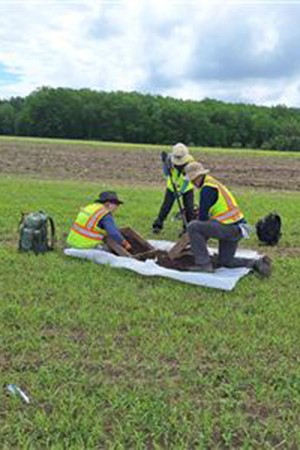
The team’s role was to determine whether cultural resources—such as archaeological sites, historic properties, or artifacts—might be present before development proceeds. To do that, Jessie and Isaiah conducted pedestrian surveys, documented field conditions, collected data, and, when needed, performed targeted shovel testing in areas with limited visibility.
“There hasn’t been a day at my internship yet where I haven’t learned something new.” —Jessie
For Jessie, one of the most interesting aspects of the project was helping assess prehistoric and historic resources within the project area. She appreciated seeing firsthand how federal regulations help project teams consider a site’s history and evaluate potential impacts before development begins.
While the fieldwork itself was rewarding, both interns gained a new appreciation for everything that happens before and after stepping onto a project site.
Jessie enjoyed seeing how archaeology contributes to larger infrastructure and renewable energy projects, while Isaiah was surprised by the amount of research, coordination, and documentation required behind the scenes.
That variety became one of the highlights of the internship. In addition to field investigations, both interns contributed to research, mapping, report preparation, and project planning, gaining exposure to the full project lifecycle rather than a single phase.
Together, the experience gave them a broader understanding of how cultural resources projects move from proposal to final report.
Learning through collaboration
For both interns, one of the most valuable parts of the experience was the opportunity to work with colleagues across offices, regions, and disciplines.
Jessie, who is based in Barr’s Albuquerque office, appreciated the chance to learn how archaeology is practiced in a different part of the country, while Isaiah enjoyed collaborating with professionals who brought diverse expertise and perspectives to the work.
“Although we may have different passions, interests, and expertise, we all care about the work we do and the safety of others.” —Isaiah
For Jessie, the experience highlighted the similarities that unite archaeologists across regions, even when methods and local practices vary. For Isaiah, it reinforced an important realization about Barr’s culture.
“Although we may have different passions, interests, and expertise, we all care about the work we do and the safety of others,” Isaiah reflects.
Just as importantly, both found a culture that encouraged learning. From field investigations and artifact identification to research and report preparation, colleagues were eager to share their knowledge and create opportunities for the interns to gain experience across the full project lifecycle.
That combination of meaningful work, mentorship, and exposure to different aspects of cultural resources management helped both interns build confidence while expanding their understanding of the profession.
Seeing the bigger picture
One lesson both interns highlighted was the value of understanding projects from beginning to end.
Before joining Barr, Isaiah hoped to gain experience in the “office side” of cultural resources work. During his internship, he had the opportunity to contribute to site forms, environmental assessment worksheets, reports, proposals, artifact identification, and background research—skills that complemented his existing field experience.
“I didn’t just gain new skills. I learned to see and practice for the bigger picture.” —Jessie
Jessie likewise appreciated the opportunity to participate in various aspects of cultural resources management and to develop a broader perspective on the profession.
“I feel more confident in archaeology holistically. I didn’t just gain new skills. I learned to see and practice for the bigger picture,” Jessie explains.
For both interns, that broader understanding was one of the most valuable outcomes of the experience. Rather than seeing archaeology as a series of disconnected tasks, they recognized how fieldwork, research, reporting, and collaboration fit together to support clients while preserving cultural resources.
Looking ahead
As Jessie and Isaiah continue pursuing careers in archaeology, they’ll take with them not only new technical skills but also a broader perspective on how cultural resources professionals collaborate to help clients move projects forward while preserving connections to the past.
Their internships provided firsthand exposure to every stage of a project—from planning and fieldwork to reporting and collaboration—while helping them build confidence in their abilities as emerging professionals.
For students considering a future in cultural resources, both interns emphasized the supportive environment they found at Barr.
“This is a place where you can try new things and know that there are people who will support and guide you,” says Jessie.
“Enjoy your time here; there’s no company like Barr,” Isaiah adds.
Interested in becoming an intern at Barr? Learn more.
About Jessie and Isaiah
Jessie Johnson is an archaeology intern based in Barr’s Albuquerque office. She is currently pursuing a master’s degree in public archaeology at the University of New Mexico and is passionate about helping people understand the value of cultural resources and the importance of preserving connections to the past.
Isaiah Gardell is an archaeology intern based in Barr’s Minneapolis office. He holds a bachelor’s degree in anthropology with a focus in archaeology from Minnesota State University, Mankato, and is currently pursuing his master’s degree. Drawn to archaeology by a fascination with ancient cultures, he enjoys uncovering clues that help tell the stories of the past.
Image gallery (below)
-
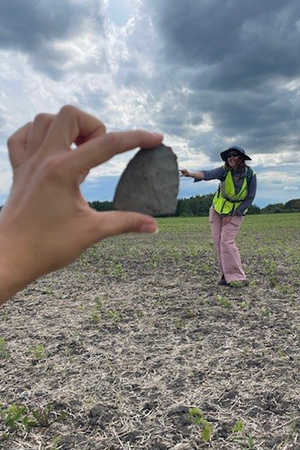
- Jessie examines an artifact identified during fieldwork, helping document and evaluate potential cultural resources within the project area.
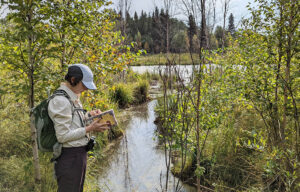
- Channeling his inner “detective of the past,” Isaiah helps uncover clues about how people used the landscape over time. He’s less confident, however, in identifying what’s growing on it today. “By the end of the project, I became a professional in still not knowing what kind of crop is being grown in this field,” he jokes.
- Fieldwork is about more than data collection. Jessie and Isaiah spend time with a Barr colleague, sharing ideas and experiences while gaining experience in cultural resources work.
- While traveling back to Barr’s Minneapolis office, Jessie takes a moment to visit Paul Bunyan, one of Minnesota’s most famous roadside attractions. Fieldwork adventures aren’t just about the work—they’re also opportunities to explore new places and build connections with colleagues and fellow interns along the way.
Image gallery