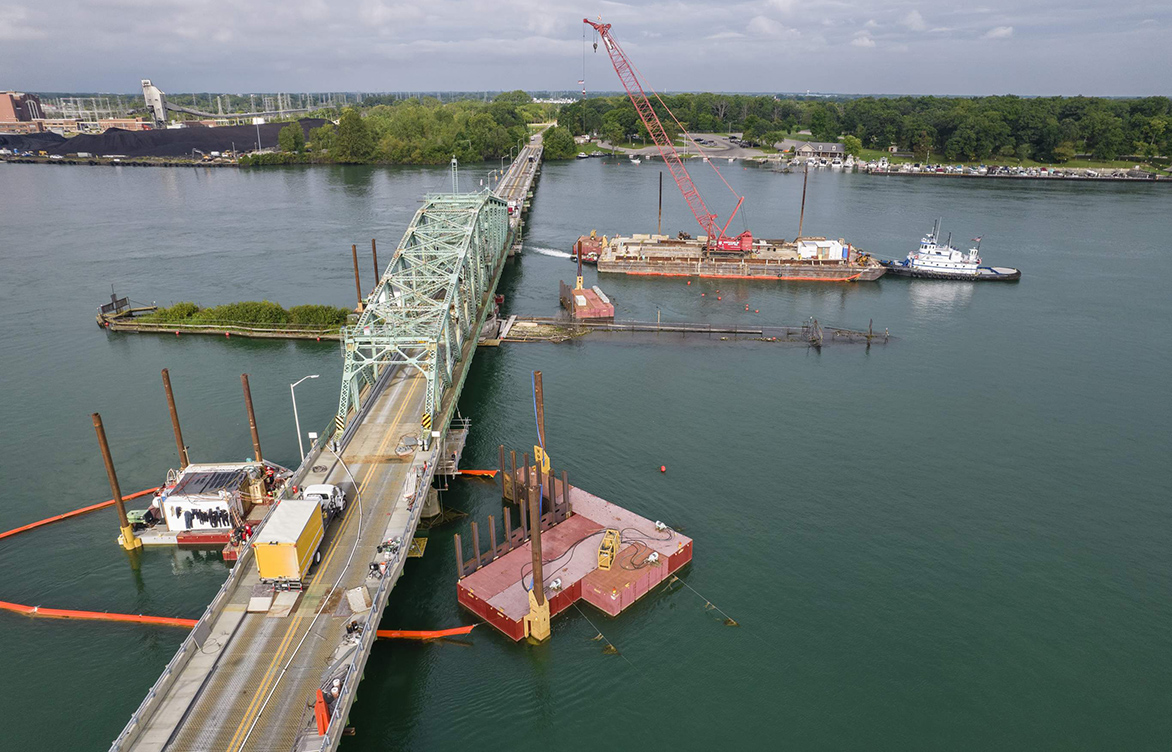
 Barr designed an L-shaped deflector upstream of a pier on the Grosse Ile Parkway Bridge near Detroit, Michigan, allowing divers to safely carry out underwater repairs on the bridge piers.
Article summary: Fast‑moving rivers make bridge repairs especially challenging. That’s why Barr—working alongside J.F. Brennan—developed a custom flow‑deflector design that creates calmer, safer underwater work zones for divers. This approach offers a smarter, more adaptable alternative to traditional underwater construction practices, even in demanding hydraulic conditions. In this article, we explore the benefits of this innovative method.
When we think about bridge maintenance, most of us picture road crews, cranes, and traffic cones—not divers. Yet, beneath the surface of many rivers, repairs to underwater bridge piers are just as important, and far more complicated. These repairs take place in fast-moving water with strong currents and limited visibility, often right next to massive concrete piers.
Despite the obvious and complex hurdles, Barr engineers, in partnership with contractor J.F. Brennan, have devised a clever solution to make that kind of work possible: redirect the river, just a little.
Deflecting flow without stopping it
While the conventional approach often involves constructing costly cofferdams, our engineers are now turning to innovative alternatives like temporary flow deflectors to manage water flow more efficiently and economically. These structures are essentially underwater walls that guide the river’s current around a safe work zone. Instead of drying out the area, these structures create a shadow of slow water, providing a window of safety to carry out repairs.
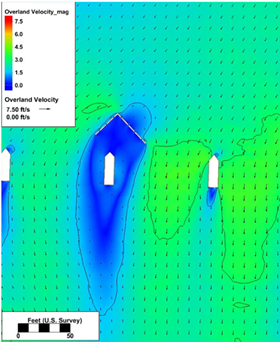
The goal of redirection is to reduce water velocity around the pier to below one foot per second, slow enough for divers to work safely and for repair materials to set properly.
Evolving designs and site-specific challenges
No two rivers are the same, so every project requires a unique approach.
No two rivers are the same, so every project requires a unique approach. River depth, flow rate, sediment type, and pier geometry are factors that help determine the deflector’s shape and anchoring. Initial designs used full rectangular enclosures around piers, but newer iterations have streamlined the design to an “L” shape. This shape is often sufficient to create the desired low-flow zone while reducing construction time and materials.
One difficulty in designing these systems is accurately estimating the forces the walls will need to withstand. Forces increase rapidly with both the speed of flow and the depth of the river, making modeling a key step in the process. Engineers use tools like HEC-RAS 2D and AdH, supported by real-world data—bathymetry, velocity readings, and water levels—to create reliable simulations before construction begins.
An inside look at the installation process
After the design has been finalized, the contractor brings in floating platforms or barges. Anchors, either heavy concrete blocks or driven anchored systems, are installed in the riverbed. Then, flow deflector panels are attached to the platform and lowered into place, forming an “L” shape.
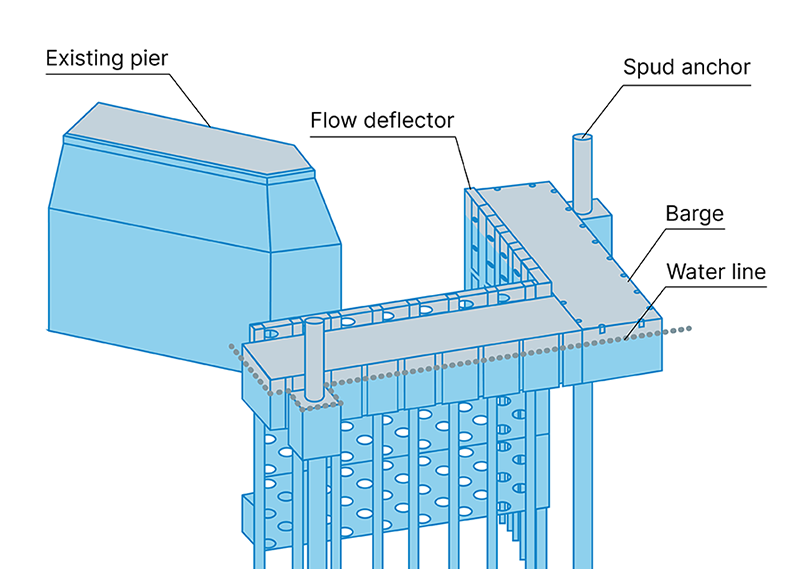
The placement of the walls is paramount: at the wrong angle, they can catch too much water or overload the anchors. When positioned correctly, the system creates a quiet zone below the river, allowing divers to make repairs.
Timing is everything
Rivers don’t pause for construction, so timing matters. Barr works closely with the contractor to define a construction window, usually during a season with lower flows and less risk of floods. To determine these windows, contractors and engineers review historical data to determine what level of flow can be expected using probability, given the contractor’s appetite for risk. Once these conditions are determined, the deflector system is designed to handle the level of anticipated force.
Lessons from the field
Barr engineers have used this method with success in several projects across the U.S. These include:
- Snake River, Idaho—This was the first project to use this deflector design, which helped refine the modeling and anchoring strategies.
- Detroit River, Michigan—This large, deep river presented high flow rates and was an ideal test of the design’s performance. Field data confirmed that the deflector successfully reduced velocities as expected.
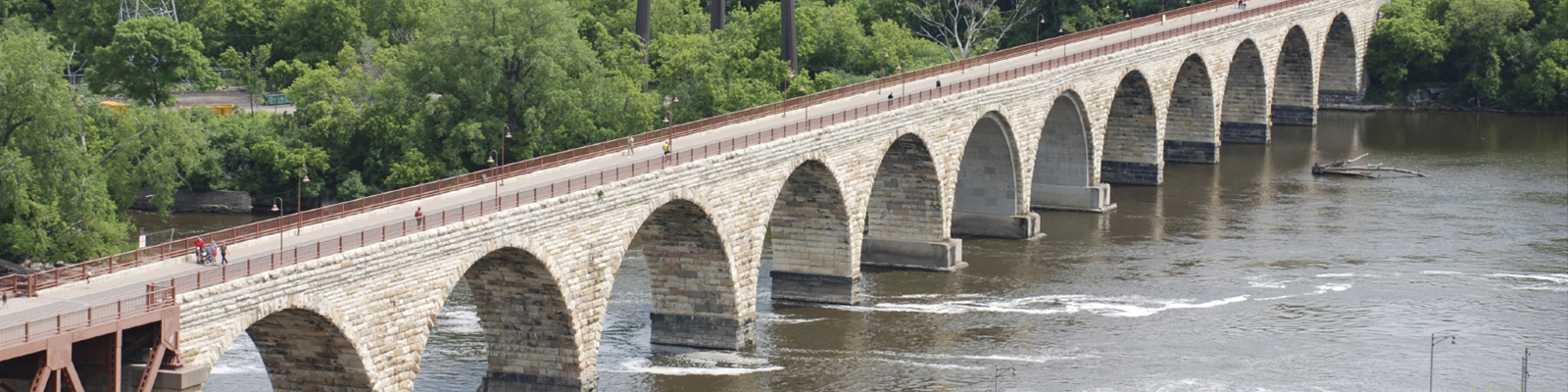
- Mississippi River, Minnesota—Conducted near the iconic Stone Arch Bridge in Minneapolis, this project applied the latest design iteration under challenging urban conditions.
From dreaming to doing
The underwater flow deflector method is one example that shows how thoughtful engineering can bridge the gap between what seems possible and what gets built.
At first, the idea of creating a calm, safe zone in the middle of a flowing major river without damming it seemed ambitious—maybe even unworkable. But, despite the obstacles, detailed modeling, tailored design, and expanding our approaches across multiple projects have created a system that is not only effective but also increasingly efficient.
The underwater flow deflector method is one example that shows how thoughtful engineering can bridge the gap between what seems possible and what gets built. Contact our team to learn how Barr’s underwater solutions could save you time and money on your next bridge repair project.
About the authors
Cory Anderson, vice president and senior water resources engineer, has 18 years of experience in water resources engineering. He specializes in hydrologic and hydraulic modeling, uncertainty analysis and risk assessments, and the design of hydraulic structures. Cory is a Federal Energy Regulatory Commission (FERC)-approved subject matter expert in hydrology, hydraulics, and consequence estimation and has extensive experience with state and federal agencies. Cory’s passion lies in understanding how water and people affect one another and in developing mutually beneficial engineering solutions to reduce risk and impact.
Brian Tri, vice president and senior civil/structural engineer, is a FERC-approved independent consultant and structural subject matter expert specializing in the inspection, evaluation, and design of dams and hydraulic structures. Over his 21-year career at Barr, he has provided civil and structural engineering design for foundations, hydraulic structures, buildings, dam repairs, and other steel and concrete structures. His wide range of responsibilities includes condition assessments of existing or damaged facilities, preparation of plans and specifications, structural design and detailing, analysis of monitoring data, project management, and field inspections.