Pipeline operators are navigating new geohazard mitigation expectations
Article summary: Pipeline geohazard mitigation designs are receiving closer regulatory review, particularly when they involve hard armoring in streams and other sensitive areas. Agencies increasingly expect site-specific justification, expanded hydraulic and geotechnical analysis, and clear plans for post-construction performance. Bringing engineering, environmental, and operational teams together earlier can reduce redesign and help operators manage risk across a portfolio of sites.
Geohazard mitigation has long been a routine part of pipeline integrity management. When stability concerns emerged, operators often took a familiar path: assess the site, develop a mitigation design, secure permits, and move forward with construction.
Today, that path is no longer as straightforward.
Designs that once moved through environmental permitting with limited review are coming back with questions about armoring approaches, project footprint, post-construction performance, and long-term channel impacts. For pipeline operators, the result is more than a permitting challenge.
What was once viewed primarily as a site-specific engineering fix is increasingly becoming a broader program-management issue.
Mitigation projects can require additional analysis, more design iteration, and closer coordination with regulators before work can begin. What was once viewed primarily as a site-specific engineering fix is increasingly becoming a broader program-management issue.
Regulators are taking a closer look at how stabilization projects interact with streams, floodplains, and surrounding habitat. They’re looking for solutions that are effective, durable, and meet evolving environmental permitting requirements.
The operators adapting most effectively are treating geohazard mitigation as more than a permitting or engineering exercise. They are bringing engineering, environmental, and operational considerations together earlier, giving projects a stronger foundation for review and aiming for long-term performance.
Rethinking hard armoring in streams
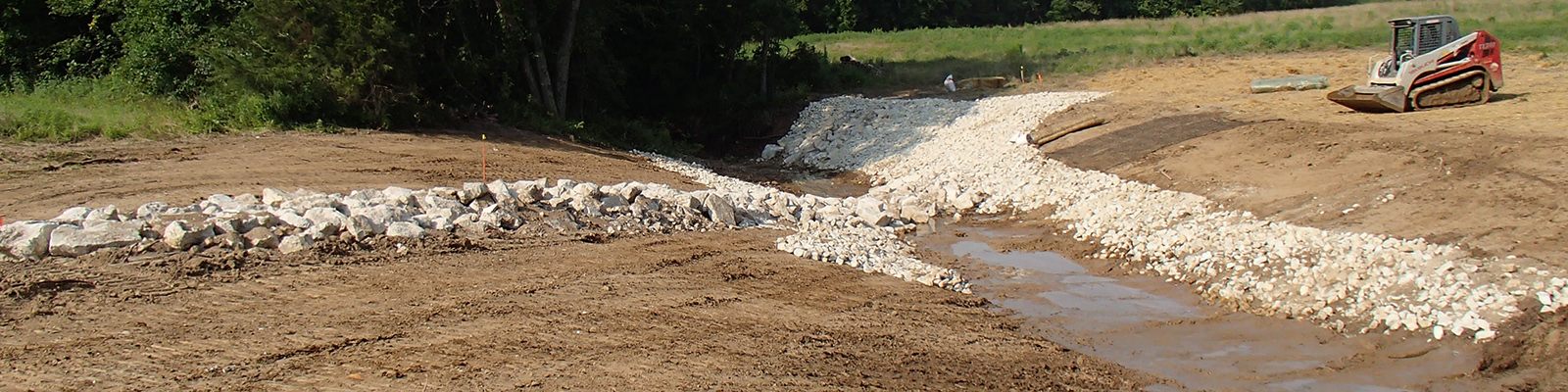
A primary focus of these shifting regulatory expectations is the design practice of hard armoring in active stream channels and along streambanks. During pre-application discussions or later in permit review, reviewers increasingly are asking for alternatives or requiring more justification for footprint and material selection.
Design teams are expected to show why a given approach fits the site and whether it can better align with the channel’s behavior. In real terms, that can mean scaling back riprap, reducing exposed structural elements, or adding features such as vegetation or grade control that manage flow energy rather than resist it outright.
We aren’t seeing this trend everywhere, however. While some regulators challenge teams to consider bioengineered or hybrid approaches, others continue to accept traditional riprap-based stabilization with the traditional level of scrutiny. That variability makes early understanding of regulatory preferences part of the work, not something to resolve later.
With more projects moving toward hybrid designs, design teams are looking at how to balance engineered stability with natural function.
With more projects moving toward hybrid designs, design teams are looking at how to balance engineered stability with natural function. The approaches often combine reduced riprap with features such as boulder riffles, vegetated benches, or soil-reinforcement systems that allow root establishment while supporting slope stability. The aim is long-term performance with less reliance on fully exposed structural elements.
That shift changes the stabilization timeline. Hard-armored sites often appear stable once construction wraps up. Sites that rely on vegetation and soil-based systems need time to establish before they reach similar performance.
Because vegetation-based stabilization measures require time to establish, post-construction responsibilities often extend further into the project’s life. Questions come up early about how long a site stays open, who is responsible for follow-up, and what triggers corrective action if performance falls short. Timing matters. A large flow event soon after construction can affect restoration stability before vegetation is established.
This does not automatically increase lifecycle cost, but it shifts when and where risk shows up. Planning for that transition should be part of the project considerations.
A higher bar for analysis and design
Design expectations are also shifting.
Geotechnical work plays a larger role. Slope stability is increasingly evaluated with location-specific data instead of relying on generalized assumptions. Subsurface investigation is showing up in places where it might have been deferred, particularly when softer stabilization approaches are proposed.
Hydrologic and hydraulic analysis is also expanding, but not always for the same reasons. Operators are looking at how larger storm events reshape channels over time and what that means for long-term stability. Agencies are focused on how design changes alter flow patterns and whether those changes could affect local flood risk. Those priorities do not always point to the same solution.
As a result, hydraulic evaluation now covers a broader set of conditions and interactions. Analysis extends beyond a single design flow to test how the channel responds under multiple scenarios, often tied to FEMA flood data and other regulatory benchmarks. That adds work during design, but it can reduce late-stage revision once agencies begin evaluating how the project may influence conditions beyond the immediate site.
When this level of analysis is built in early, it strengthens the basis for permitting and helps avoid redesign late in the process.
Programmatic planning is replacing site-by-site fixes
These changes add up quickly across large systems. Addressing issues one location at a time becomes harder to sustain.
Effective programs start with a phased assessment. Teams use aerial imagery, lidar, and inspection records to screen for potential issues. Then, fieldwork confirms the drivers of instability. This narrows the list before design begins, gives regulators a clearer starting point for review, and helps identify where hybrid approaches make sense and where traditional armoring still carries the least uncertainty.
Teams that integrate environmental permitting and engineering early are better positioned to adjust before designs are locked in and avoid late-stage revisions.
The line between design and permitting is less distinct. Permitting now shapes design decisions early, especially for projects involving wetlands and other sensitive areas. Teams that bring environmental permitting and engineering together early are better positioned to adjust before designs are locked in and to avoid late-stage revisions.
For operators, that often means tighter coordination across integrity management, environmental compliance, and operations groups, particularly when monitoring extends beyond a single construction season.
From isolated fixes to system-level decisions
Hard armoring remains necessary in many settings, but it no longer moves through environmental permitting by default. Each site requires a clearer case for why that approach fits the conditions and meets agency expectations.
The larger challenge sits at the system level. Technical analysis, environmental permitting constraints, and post-construction performance now interact across an entire portfolio of sites. Decisions in one location can affect how others are prioritized, permitted, and managed over time.
Managing that interaction is where most of the schedule risk sits today.
If you are navigating these challenges, we can help you make sense of shifting expectations and build a more consistent, system-level approach. Contact our team.
About the author
Heather Lewis, vice president and senior civil engineer, has 25 years of experience in civil and environmental engineering, including more than 12 years in pipeline installation and remediation design. This work has included extensive project management experience for a liquids pipeline company as a project manager for depth-of-cover and exposure pipeline remediation projects. She specializes in project and construction management of pipeline systems, plan and specification development, and coordination with permitting agencies and public officials.