Xcel Energy retained Barr to complete a supplemental geotechnical evaluation for a wind repowering project. The evaluation included assessing soil behavior subjected to cyclic foundation loading for the proposed repower locations. The field campaign focused on undisturbed thin-wall samples collected at a depth corresponding to the base of the turbine foundation, while the laboratory testing program centered on cyclic triaxial strength to assess the behavior of the soil under enhanced foundation loading associated with the repower.
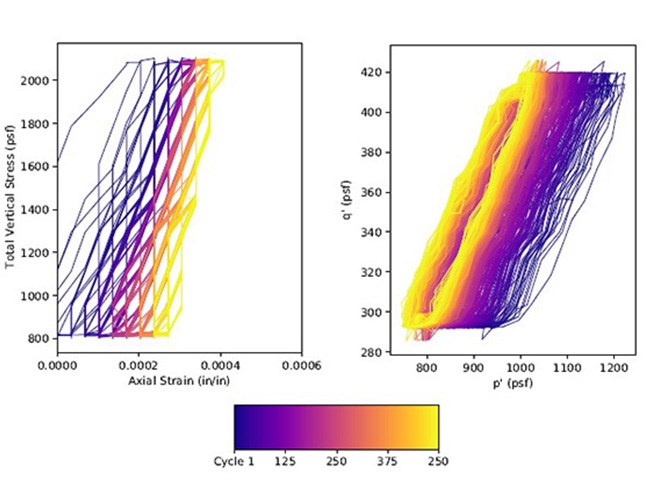
Numerical modeling was performed with FLAC, which allows for the computation of stresses induced in soils in response to changing structural loads at the surface. Using FLAC, the cyclic behavior of the major and minor principal stresses and corresponding shear stress were determined. Significant variations were found in the stresses relative to a small, corresponding variation in shear stress. Cyclic testing was completed with stress-path sequencing in a triaxial chamber, in which the major and minor stresses underwent 250 full cycles (calculated via the damage equivalent method to approximate loading for the operational life of the wind turbine). The stresses were computed from the FLAC model described previously.
In this study, the following criteria were used:
Settlement: Differential settlement induced by cyclic loading is anticipated to be minimal based on measured cumulative axial strain.
Stiffness: Constant or increasing Young’s modulus results indicated either neutral conditions or an improvement of the foundation subgrade soil stiffness.
Strength: The undrained shear strength of soils for cycled specimen strength testing was found to exceed the design requirement.
The soil samples were found to not be susceptible to significant degradation, and therefore, expensive foundation retrofits were deemed unnecessary for the repowering effort.