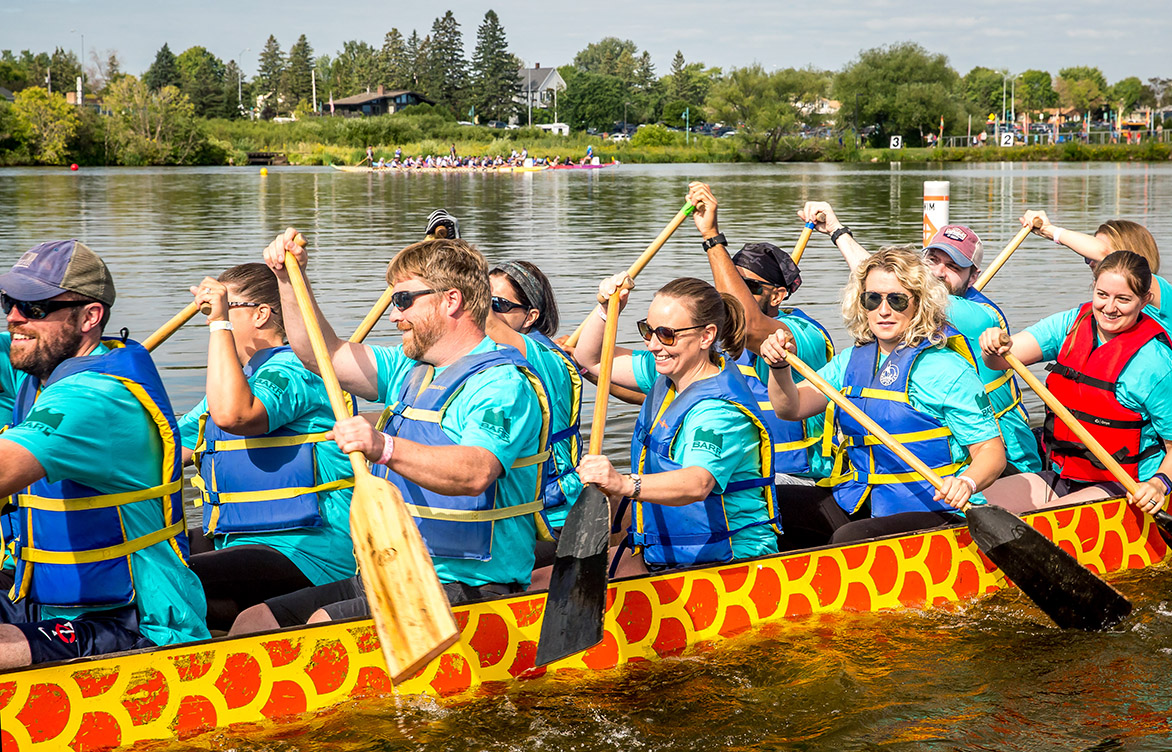
 For 18 years, Barr employee-owners have raced in the Lake Superior Dragon Boat Festival, demonstrating the teamwork, trust, and shared commitment that define our employee-owned culture and help power our success.
Article summary: As Barr celebrates Employee Ownership Month and its 60th year as a company, President and CEO Ward Swanson reflects on the role employee ownership has played in shaping our culture, client relationships, and long-term success. Learn how Barr’s 100 percent employee-owned ESOP model empowers employees, strengthens communities, and helps us deliver exceptional outcomes for our clients.
Barr clients may not choose us simply because we’re employee-owned. And top professionals may not join our team solely because we have an employee stock ownership plan (ESOP). Yet after 60 years in business, I’d argue that employee ownership may be our hidden superpower.
Barr is among a small subset of ESOPs that are 100 percent employee-owned. Every one of our 1,200 employees can become an owner—and the vast majority do so. Our ownership model defines how we serve clients, build and sustain relationships, create opportunities for employees, make decisions, and operate our business. Employee ownership influences nearly every aspect of how we operate. Here are a few of the ways it makes a difference every day.
Long-term client relationships
We don’t chase aggressive growth targets at Barr; we act in our clients’ best interests and strive to foster long-term partnerships. We can do this because we don’t serve external shareholders or majority owners who expect quarterly returns on their investments. We answer only to our clients and ourselves as employee-owners. This builds trust—and relationships that span decades.
Engaged, high-performing employees
When employees own the place, we can steer our efforts toward meaningful work. From climate resiliency to critical minerals supply, Barr works on some of society’s most important challenges. Our project work is interesting; the stakes are often high, and the outcomes matter. Our engineers, scientists, and technical experts choose assignments based on their skills, interests, and intrinsic motivations rather than taking direction from supervisors. This professional freedom contributes to employee engagement levels that consistently exceed industry benchmarks.
A culture defined by ethics and sound decision-making
Being an employee-owner makes you a steward of the company—not just for yourself, but for future generations.
Being an employee-owner makes you a steward of the company—not just for yourself, but for future generations. We want to keep a good thing going for the future staff members who will inherit our company. Discussions about company performance are transparent and rigorous, much like the conversations many families have around the kitchen table about finances, just on a different scale. Barr employees operate in a high-trust, high-accountability environment, in which long-term outcomes matter more than quick wins, and ethics are paramount.
Bold action and innovation
Recently, a relatively new Barr employee who previously held senior positions elsewhere told me something striking: Barr was the first place she’d worked where she perceived an “absence of fear.” When people are expected to “act as owners,” they question the premise, challenge leaders, bring forward new ideas, and sometimes, fail. We understand that making mistakes and learning from them are part of the equation for long-term, sustainable success. When people know this, I believe it boosts their confidence, unleashes creativity, and fosters innovation.
Leadership and succession
We pay close attention to the insights our employee-owners gather from clients because that’s what makes a truly client-centric organization work.
At Barr, we set our strategic direction and determine annual plans through collective efforts that incorporate direct input from staff across the organization. We pay close attention to the insights our employee-owners gather from clients because that’s what makes a truly client-centric organization work. We’re deliberate about succession planning, using our inclusive planning process to not only shape priorities but also prepare future generations to lead the company.
Stronger communities
The benefits of employee ownership extend well beyond our company. When company profits are returned to employees, as ours are, these funds flow into their households as discretionary income that reaches local economies, charitable organizations, schools, and more. Beyond individual financial rewards, we distribute two percent of our profits annually to nonprofits across all our locations. Employee-owners within each community form groups to decide how to distribute these funds, often selecting organizations they also support as volunteers.
A promising future
At Barr, we can play the long game thanks to our employee ownership model. It enables us to focus on long-term outcomes that benefit clients, our company and careers, and our communities.
For all these reasons, we’re proud to celebrate employee ownership during October, Employee Ownership Month. As we look toward the future, we’re grateful for the clients, partners, employee-owners past and present, and fellow ESOP organizations who make this model successful and help sustain it for future generations.
Curious about what employee ownership looks like in practice? Contact us to learn how our ownership model influences the way we serve clients, develop leaders, and invest in our communities.
About the author
Ward Swanson began serving as Barr’s president and CEO in 2021 and has overseen the company’s sustained success and geographic expansion. Throughout his dynamic career, Ward’s work has centered on helping clients solve complex issues related to the environment. In addition to holding numerous leadership positions at Barr, he is a nationally recognized expert on chemicals of concern, such as per- and polyfluoroalkyl substances (PFAS). His three decades of experience also encompass environmental laboratory expertise, specialized environmental analysis, and business and market leadership.