
BIOTIC LIGAND MODEL

In October 2025, the Windward Environmental LLC team joined Barr Engineering Co. Learn more.
Biotic Ligand Model Overview
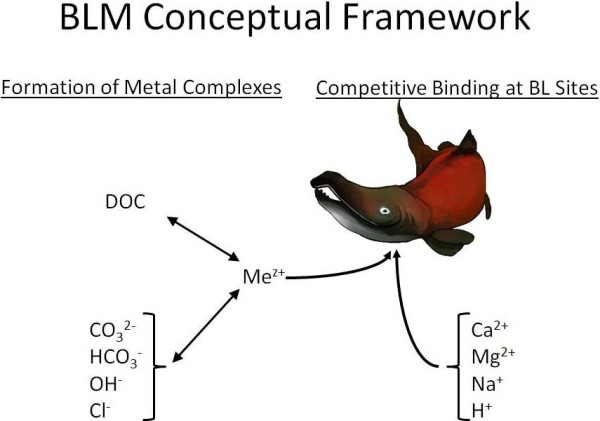
The bioavailability of metals in aquatic systems (i.e., the amount of metal that is available for uptake by organisms) is highly dependent on several factors. For example, dissolved organic carbon (DOC) in the water binds metals, cations (such as calcium) can compete with metals for uptake by an organism, and pH and alkalinity affect metal speciation (Figure 1). For a metal like copper, bioavailability is greatest in waters with low DOC, low hardness, and low pH; bioavailability generally decreases as any one of the parameters increases. Other metals, such as aluminum, have more complex speciation. For example, highly bioavailable forms of aluminum can occur at both pH 6 and 8, but less bioavailable forms occur at pH 7. The biotic ligand model (BLM) is a tool that can mechanistically predict the bioavailability of a variety of metals under the large range of water chemistry conditions that are observed in nature.
The BLM is scientifically robust and defensible, user-friendly, and freely available for download from this website. Submit your information in the form below to access the downloadable biotic ligand model.
Current BLMs
- Freshwater: aluminum, cadmium, cobalt, copper, nickel, lead, and zinc
- Saltwater: copper, nickel, and zinc
Examples of BLM Applications
- The US Environmental Protection Agency’s (EPA’s) recommended freshwater ambient water quality criteria (AWQC) for copper are based on the BLM. (BLM-based saltwater AWQC for copper in saltwater are pending.)
- BLM-based, environmentally protective levels for several other metals have been developed or are currently in development (e.g., aluminum, cadmium, lead, nickel, and zinc).
- Site-specific water quality criteria can be developed for use in determining effluent permit limits, or in state-wide water quality assessments required under Section 305(b) of the Clean Water Act.
- The BLM can be used to support site-specific ecological risk assessments.
- For toxicity identification evaluations (TIEs), the BLM can evaluate potential causes of toxicity in whole effluent toxicity (WET) tests.
- The BLM can also be used to evaluate the bioavailability of metal mixtures.
Submit the form to download
Phone: (206) 812-5450