

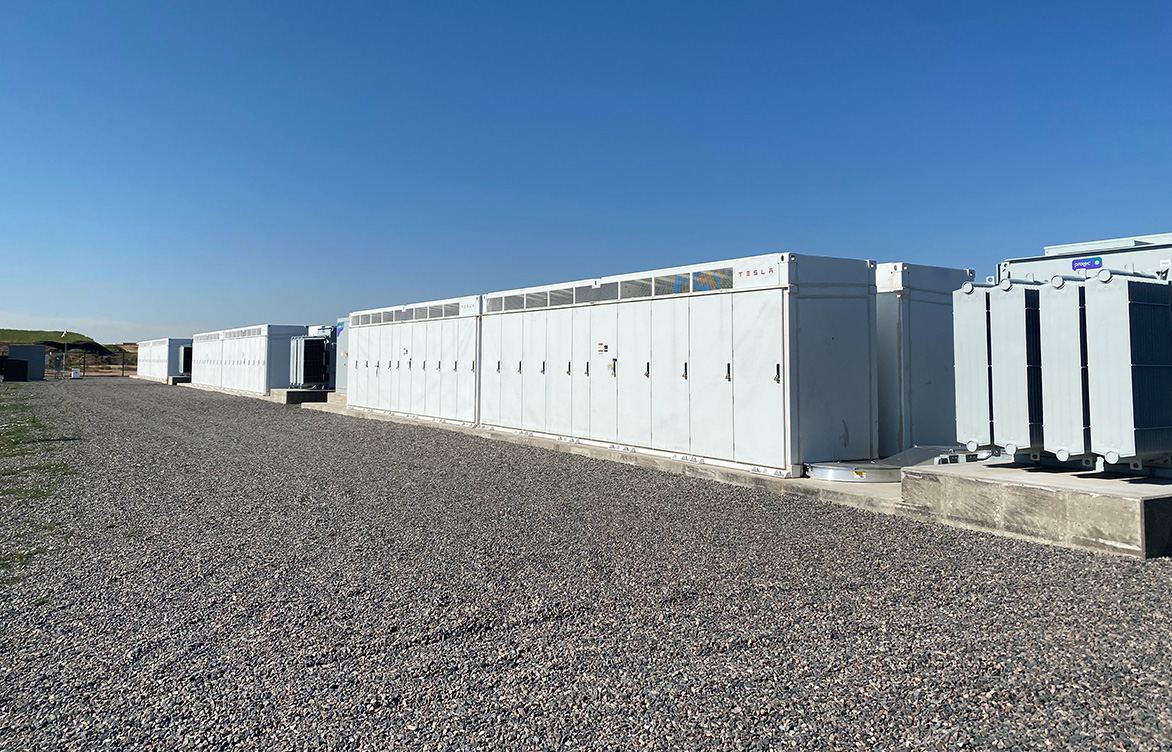
 Rows of Tesla Megapack batteries and transformers were installed on concrete foundations at a United Power substation—one of eight new BESS units installed across United Power’s service area.
Betting on BESS: Energy storage insights from Colorado
Article summary: As Colorado’s Front Range grows, power utilities are under pressure to meet rising demand without overloading grid infrastructure. This article explores key planning and design elements behind eight large-scale battery energy storage systems (BESS) that are now helping an electric distribution cooperative meet peak demand, protect grid infrastructure, and control costs. Discover real‑world lessons on permitting, siting, and interconnection that can inform future BESS projects.
From Pueblo to Fort Collins, Colorado’s Front Range is booming. As its stunning Rocky Mountain backdrop and sunny climate draw thousands of new residents, power utilities are modernizing their infrastructure to meet the rising demand for electricity and stabilize the grid at a reasonable cost. By storing energy for when it’s needed most, battery energy storage systems, known as BESS, offer a powerful solution.
Power utilities are investing in BESS for their benefits to peak shaving, which is the practice of reducing demand on the electrical grid during periods of peak consumption. This works by charging the BESS with power from the grid when demand and prices are low—when most of us are sleeping, for example. Then, once we’re awake and flipping switches on our coffee makers and toasters, or in the evening when everyone is back home and firing up the oven, utilities can discharge the BESS, reducing the amount of electricity drawn from the grid by meeting some of our demand with battery-stored electricity. Because peak-demand charges are based on the highest amount of electricity drawn from the grid over a rolling period, peak shaving creates substantial savings for both a utility and its customers. It also helps to prevent transformers, substations, and transmission lines from overloading, thereby extending the life of critical power infrastructure.
As with many emergent and evolving technologies, however, integrating BESS into existing infrastructure isn’t straightforward. From navigating shifting regulations to tackling siting, design, and grid connection challenges, every project requires a customized, multidisciplinary approach and a unique level of precision.
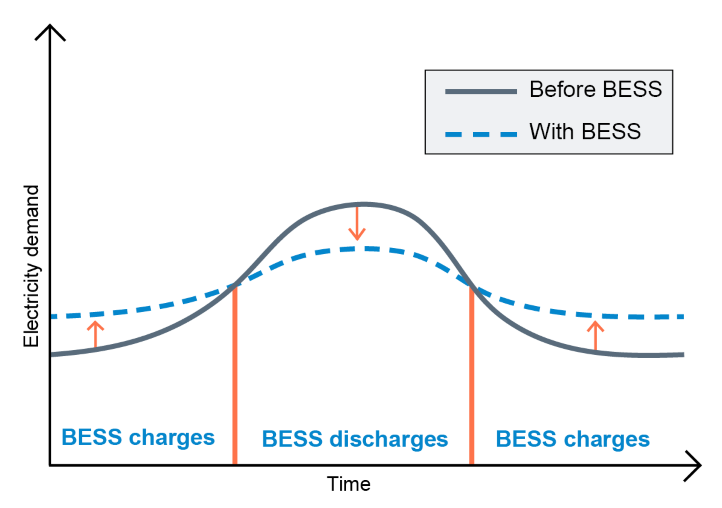
BESS charges, or stores energy, when electricity demand is low and discharges, or releases energy, when demand is high. This effect, known as peak shaving or load shifting, reduces stress on the grid and helps utilities manage peak-demand charges more effectively.
A bright success story comes from northeast of Denver, along Colorado’s north-central Front Range, where United Power, Inc. (United Power) has recently deployed eight BESS across its distribution system to help with peak shaving. In 2022, the not-for-profit electric distribution cooperative selected Ameresco, Inc. (Ameresco) as the developer and eventual owner of the BESS. Ameresco looked to Barr as the lead engineer for the siting and feasibility studies, permitting, and civil, foundation, and electrical designs for all eight BESS units. Completed in 2024, the units have a collective capacity of 78 MW and 313 MWh—approximately 13 percent of the utility’s current peak load.
“This initiative, the largest of its kind in Colorado to date, illustrates the multifaceted nature of BESS design and offers valuable lessons for future utility and industrial applications alike,” said Tom Ghidossi, vice president and senior electrical engineer in our Fort Collins office. Tom has designed large-scale power systems for utilities, mines, and other industries for more than four decades, and he’s passionate about helping operators integrate new technologies. Working with United Power, Ameresco, and the design team at Barr over the two-year effort, he’s learned a great deal that he’ll apply to future BESS projects.
Crossing uneven regulatory terrain
The eight BESS sites span three counties, necessitating multiple distinct permitting processes at a time when BESS have yet to be addressed in most local codes and ordinances. “Often, local governments treat BESS as buildings, which triggers requirements related to egress, HVAC, and even plumbing, but you can’t crawl inside a battery pack,” said Darcy Tenan, senior electrical engineer and project manager. “Each of the regulators we worked with saw BESS a little differently, and as a result, permitting requirements varied widely.” Permitting involved more collaboration, consultation, and partnership, with Barr providing extra information where needed and certifying design drawings (a common requirement for occupied buildings) as requested.
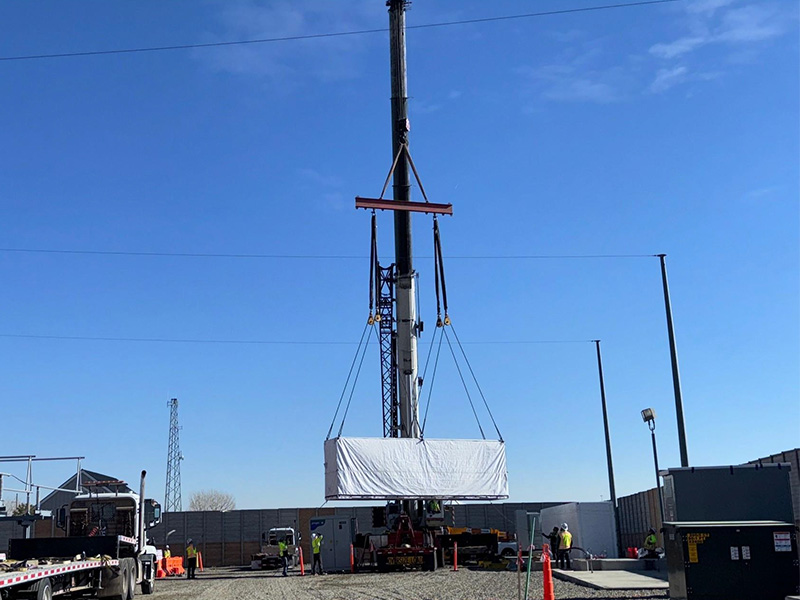
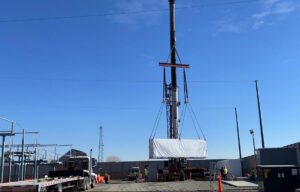
A Tesla Megapack is suspended in mid-air during lifting. Two tag lines enabled controlled and safe handling of each 80,000-pound-plus battery.
Lagging codes and ordinances for shipping-container-sized lithium-ion batteries make fire safety a priority concern for regulators. Some governments have even placed moratoriums on BESS installations due to uncertainty around appropriate fire suppression protocols. This means that developers should engage with fire departments early. For instance, Ameresco provided specific training to a local fire district, and, at the district’s request, added specific information to exterior signage for public awareness.
Permitting may seem like a rocky road for now, but Tom thinks it won’t be for long. He’s on the Energy Storage & Stationary Battery Committee of the Institute of Electrical and Electronics Engineers (IEEE) Standards Association, which plays a central role in shaping international standards and best practices for BESS. Right now, the committee is working on IEEE P3434, “Draft Guide for the Life Cycle of Energy Storage System Projects.” Tom is leading the development of the document’s design-related guidance, which he hopes will result in more specific and consistent local ordinances and permitting requirements for BESS.
Eight solid foundations
The sites for the new BESS units were chosen for both operational practicality and physical feasibility. Geotechnical conditions were a key driver of site selection due to their influence on foundation design and the burial of transmission cables connecting the BESS units to the substations. Thorough geotechnical investigations proved to be critical. At one site, an old underground mine was causing ground subsidence, which required unique mitigation measures in the design. At another site, early excavation revealed an unmapped power line, necessitating adjustments to the site layout. The lesson learned? Complete the geotechnical homework: understand legacy land uses, and don’t just call 811—dig plenty of test holes.
With site layouts and designs tailored to conditions both above and below ground, the foundation work could begin. The BESS units rest on concrete slab foundations that support not only the massive batteries—each weighing over 80,000 pounds—but also their transformers, switchgear, and metering cabinets. “Manufacturer specifications for the batteries allow very little differential settlement—just half an inch over approximately 30 feet—to maintain critical alignment between the batteries and their transformers that prevents damage to sensitive electrical equipment,” said Rob Morrow, senior civil/structural engineer and engineer of record for all eight sites. “We had to design deep, robust foundations, which required close coordination among the geotechnical, civil, structural, and electrical teams all the way through construction.” To prevent settlement, which is often caused by repeated freezing and thawing of soil around foundations in Colorado, the final design called for a minimum of four feet of frost-resistant fill to be placed on all sides of the concrete slabs, requiring significant excavation around the foundation sites.
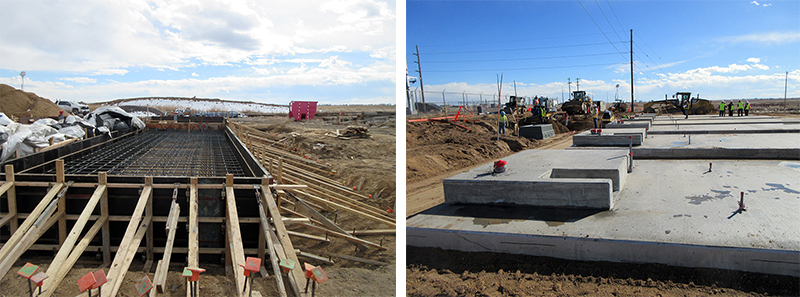
Left: Large, reinforced foundation forms with supports are in place, ready for the concrete pour. Right: The concrete foundations are complete. Each foundation included an elevated slab for a transformer—one for every two batteries—which aligned the transformers and batteries so that a level cable tray (shown below) could be installed between them.
Integration and control: Making the BESS work, safely
In addition to being well sited and physically stable, BESS must be dispatchable—capable of responding to control signals from both the electrical distributor and the BESS operator. Barr helped United Power and Ameresco establish the physical and operational interconnection between the BESS units and United Power’s substations. This required designing control systems and implementing operational measures that would allow United Power to charge and discharge the batteries at specific times while enabling both parties to isolate the BESS as needed for maintenance or safety purposes. This coordination, facilitated by Barr, culminated in detailed interconnection agreements between the two parties.
An interconnection agreement centers on the physical and operational boundary between Ameresco’s BESS units and United Power’s substation, referred to as the point of common coupling (POCC) or point of connection, which Barr designed. It houses precisely engineered metering, protection systems, and disconnect switches that enable both parties to execute their operational responsibilities. If the POCC is not properly aligned in terms of electrical parameters, physical setup, or operational coordination, serious problems may arise, such as unwanted voltage fluctuations, surges, or failures. The engineering behind the interconnection of BESS and electric power distribution systems is so critical that it’s the subject of multiple IEEE standards and related guidance (IEEE P1547).
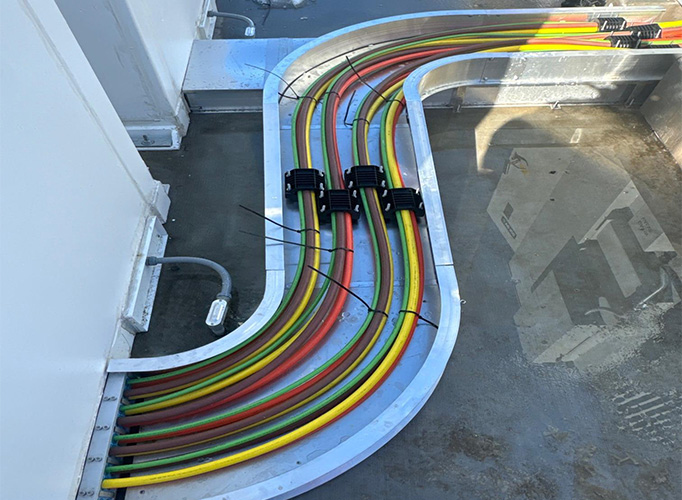
Cables between the batteries and transformers were carefully routed and mechanically restrained to prevent overheating and withstand fault conditions. Specialized equipment secured cables within trays, ensuring compliance with IEEE and National Electrical Code (NEC) safety standards.
Most of United Power’s BESS units are located next to substations, allowing for dedicated feeders (medium-voltage cables connecting the BESS to the substation) and a relatively simple POCC located at a single metering station. It’s not always so simple—two of the sites are connected to feeders that served other customers, introducing complexity in load management and protection. In these cases, we worked closely with United Power to adjust local configurations so that the BESS could operate reliably and safely.
Lessons learned
Our takeaways |
|
With electrification on the rise, BESS are quickly becoming foundational to North America’s energy future, and thanks to developing standards from IEEE and the National Fire Protection Association, the process of planning, designing, permitting, and deploying them is slowly becoming clearer and safer. We also learn from practice. Ameresco and United Power’s BESS project offers a wealth of lessons not just for utilities but also for commercial, industrial, and public service providers considering BESS for improved energy reliability, lower energy costs, or renewable energy integration.
“Any utility, industrial operator, commercial operator, or developer planning a BESS project should expect to engage with cross-disciplinary engineering teams and embrace the variability of site constraints and regulatory environments,” said Tom. “Projects like United Power and Ameresco’s demonstrate that with the right expertise and collaboration, large-scale BESS can deliver transformative value. Getting it right means understanding that every site, every connection, and every control signal matters.”
Considering battery energy storage? Connect with us.
Whether for utilities, power suppliers, or mines, Barr understands what it takes to integrate battery energy storage into an existing power system. With expertise in all aspects of energy storage engineering and design, we can help you realize the energy storage solution that best fits your needs now and in the future. Contact our electrical engineering team.
About the authors
Tom Ghidossi, vice president and senior electrical engineer, has more than 40 years of experience as a principal and project manager for electrical engineering projects. He specializes in designing and analyzing low-, medium-, and high-voltage power systems, with expertise in protective relaying and communications, and focuses on large substation, generation, and transmission/distribution projects. Before joining Barr, he founded Exponential Engineering Company in Fort Collins, Colorado. An active clean-energy leader, Tom has helped advance renewable integration and is committed to developing reliable, affordable power systems through distributed energy, microgrids, and storage.
Darcy Tenan, senior electrical engineer, has over 20 years of electrical engineering and project management experience in transmission and distribution, protective relaying, planning, studies, substations, and severance analyses for power generation plants, public utilities, industrial facilities, and cooperatives. She has extensive experience in the design of transmission and distribution lines, including analyzing existing lines, structure strength, and performance for structure-type selection. Darcy was Barr’s project manager for United Power and Ameresco’s BESS project.
Robert Morrow, senior civil/structural engineer, has over 17 years of experience in civil and structural engineering and project management, specializing in the design of electrical substations, transmission and distribution lines, and BESS. Rob has been the lead foundation engineer on multiple large-scale BESS projects throughout the United States, involving the design of both concrete and structural steel support systems. He designed the foundations for United Power and Ameresco’s BESS project and served as the engineer of record for all eight sites.