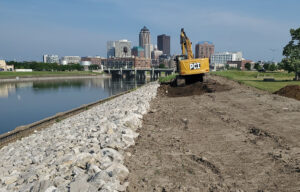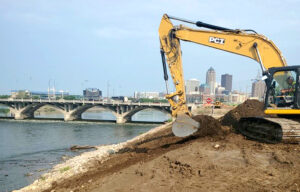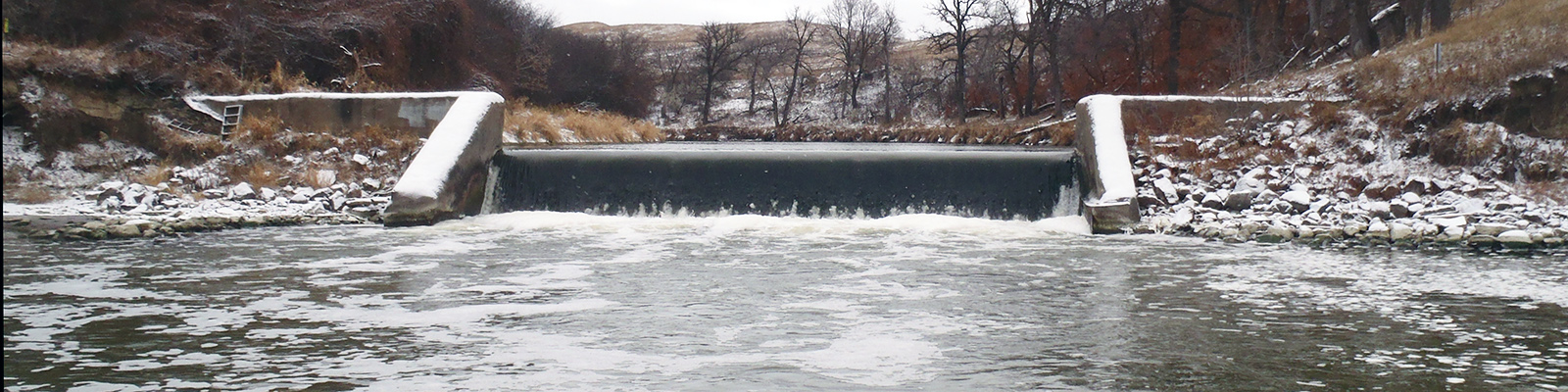
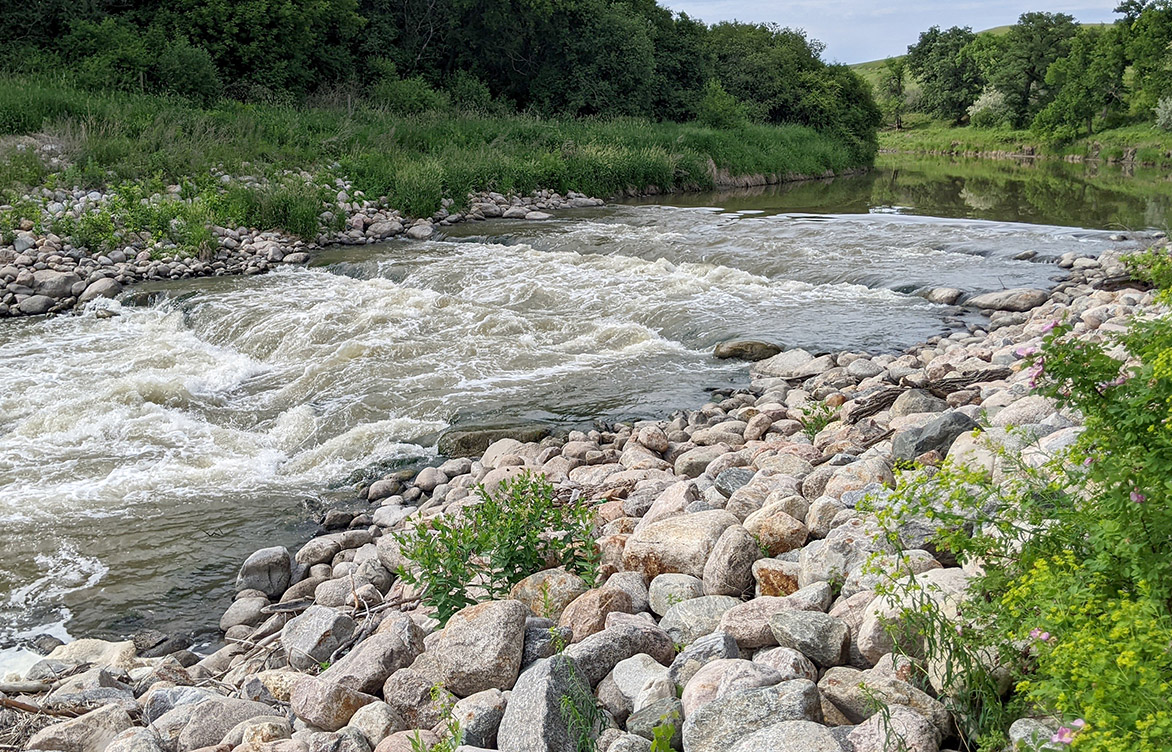
 Before and after: The aging Kathryn Dam on the Sheyenne River in North Dakota was replaced with a rock-arch rapids, eliminating the dangerous hydraulic roller while providing fish passage and recreational features.
Article summary: The dam-safety community has made important progress in identifying low-head dams and raising awareness of the dangerous hydraulic conditions that may exist. But once a potentially dangerous structure has been identified, what comes next? This article outlines five questions dam owners can ask to define site needs, evaluate alternatives, and move from hazard awareness toward practical, site-specific action.
As an industry, we’ve gotten very good at assessing information, spotting trends, and identifying safety issues. But the real work is what comes next: finding solutions.
That thought stayed with me after attending the recent Association of State Dam Safety Officials conference. We heard a lot about the work being done to identify low-head dams, notify the public about their hazards, improve inventories and fatality databases, and use new technologies to locate structures that may not have been recorded previously.
All of that work is exciting and important. Low-head dams can appear relatively harmless, but under some flow conditions, they can create dangerous recirculating currents, or hydraulic rollers, capable of trapping people and watercraft. The hazard can be difficult to recognize but exists across frequent flow events at many low-head dams.
If you own a low-head dam and know it poses a potential safety risk, what do you do about it?
The conference was fantastic, and the information was valuable, but there was one part of the conversation I wanted to hear more about: If you own a low-head dam and know it poses a potential safety risk, what do you do about it?
That’s a harder question.
Identifying a structure and recognizing its potential risk is one thing. Determining what should happen to it is inherently more site-specific. And making that fit within a limited budget adds to the complications. Removing the dam may be one possibility. Retrofitting or modifying the structure to address the hydraulic roller may be another. The appropriate solution depends on the dam, the river, and what the owner and the surrounding community need from both.
So perhaps the conversation needs to shift slightly from “Is this a problem?” to “What can we do about it?”
And a good place for dam owners to start is not necessarily with a particular engineering solution. It’s with a few questions.
1. Why is the dam there, and does it still serve that purpose?
Historically, low-head dams have been used to power mills, divert water for irrigation, maintain upstream water levels, reduce channel erosion, support municipal or industrial water supplies, and create recreational impoundments. Some of those original purposes have been reduced or removed, while others remain important to communities and water users. A dam that no longer serves a necessary function may be a candidate for removal, while a structure that still maintains a critical water level or diversion may require modification or replacement that preserves that function while improving safety.
Before deciding what to do with a low-head dam today, owners should understand its original purpose and whether the dam still serves it. Is the dam still needed for its historical use? Has that use changed? Does it affect water users upstream or downstream? Does the structure provide other functions that need to be maintained? Those answers help establish the constraints and opportunities surrounding any potential modification or removal.
2. How is the river and reservoir being used today?
Understanding the structure is only part of the equation. Owners also need to understand what has developed around it.
How are people using the river today? What is the reservoir used for? Is recreation part of the picture? Are there ecological considerations or upstream and downstream users that need to be accommodated?
Understanding the structure is only part of the equation. Owners also need to understand what has developed around it.
Those questions can change what “success” looks like. A low-head dam is not an isolated hydraulic feature; it is part of a river system that transports water, sediment, debris, provides habitat connectivity and recreation, supports infrastructure, and experiences flooding. Looking at the entire river system helps avoid solving the hydraulic hazard at the dam while unintentionally creating a different problem elsewhere.
The objective is broader than eliminating a single hydraulic roller. A successful solution must improve public safety while continuing to meet the owner’s essential water-use objectives, while accounting for ecological function, channel stability, recreation, maintenance, and resilience during future floods.
3. What do you want this site to become?
Safety may be the immediate reason for evaluating a low-head dam, but it doesn’t necessarily have to be the only objective.
One of the questions we ask is whether an owner wants people to avoid the site or whether there is an opportunity to rethink it as a place people actively use. Could changes support recreation or help create a public gathering place? Or are there reasons access should remain limited?
The answer matters because a low-head-dam project can involve more than eliminating a hazard. Barr project experience includes dam modifications and removals in which considerations have included fish passage, river connectivity, recreation, erosion, long-term maintenance and preservation of upstream water levels or other functions.
4. What alternatives should be on the table?
There isn’t a single answer for every low-head dam, and “remove it” and “leave it alone” aren’t the only choices. The alternatives generally fall into several broad categories:
- Remove the dam. Full removal eliminates the dam-created hydraulic roller, but the evaluation must address sediment, channel adjustment, infrastructure, water levels, habitat, permitting, and effects on upstream and downstream users.
- Partially remove or lower the structure. Partial removal may reduce the hydraulic hazard while retaining some water-level control or other site functions, although the remaining structure still requires hydraulic evaluation.
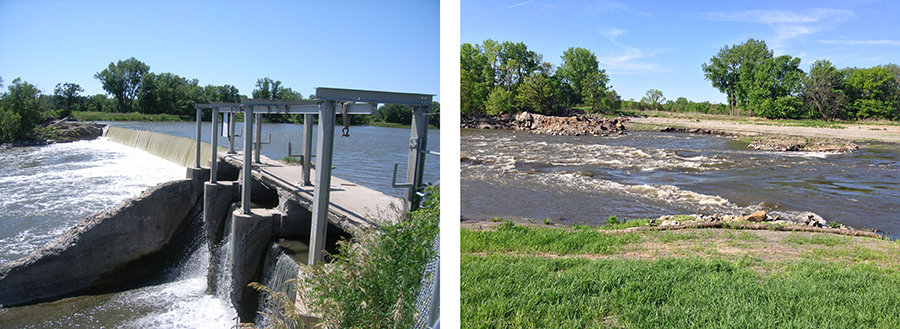
- Replace the dam with a nature-like grade-control feature. Rock ramps, rock-arch rapids, riffles, and step-pool configurations can maintain elevation control while dissipating energy and potentially improving fish passage and river connectivity.
- Modify the existing structure. Steps, wedges, ramps, flow deflectors, baffles, or related features may be used to interrupt channel-wide recirculation and create downstream-directed flow or escape paths.
- Use interim and complementary safety measures. Signage, barriers, access controls, public education, and emergency-response planning may reduce exposure, but they should not be mistaken for permanent correction of dangerous hydraulic conditions.
Each approach presents its own considerations, which is why understanding site conditions and objectives should come before selecting the solution. In other words, the goal shouldn’t be to start with a preferred fix and make the site fit it. The goal should be to define what the site needs to accomplish and evaluate the alternatives accordingly.
5. How do we define the best solution?
Cost matters, but the lowest upfront cost may not provide the best long-term value. The best solution is the one that reliably reduces the hazard, preserves the site’s essential functions, and avoids unacceptable impacts elsewhere in the system.
A low-cost fix that addresses one problem while creating or ignoring others may not be the best long-term answer. In our work, that means considering the owner’s water-use objectives alongside public safety, recreational use, ecological function, resilience, and life-cycle cost. The relative importance of those factors will differ from site to site. Barr’s role is to make the tradeoffs visible, test whether the alternatives will perform across the relevant range of river conditions, and help the owner select a solution that is both effective and sustainable within the available budget.
The solution also needs to reflect the specific site. That’s what makes this part of the low-head-dam conversation more exciting than simply identifying where these structures exist. But it’s also where engineers and dam owners have an opportunity to advance the discussion.
From identifying problems to solving them
As a dam-safety community, we need to continue improving inventories, documenting incidents, educating the public, and using better technology to understand where low-head-dam hazards exist. Those efforts help us see the problem more clearly.
But identification shouldn’t be the endpoint.
Once an owner knows there’s a problem, the next question is obvious: What can we do about it?
Owners should be able to learn from completed projects, understand which approaches were considered, and see how those solutions performed after construction. That is where I believe the industry needs to go next.
There may not be one universal answer. Every site brings its own history, hydraulics, users, environmental setting, and objectives. But site-specific does not have to mean starting from scratch. Owners should be able to learn from completed projects, understand which approaches were considered, and see how those solutions performed after construction.
That is where I believe the industry needs to go next. In addition to improving inventories and documenting incidents, we begin by asking what the dam does today, what the river needs to do tomorrow, and what alternatives can meet those objectives while improving public safety. That turns awareness into decision-making and ultimately into action.
At Barr, we are engaged in working with owners, regulators, and operators to navigate these questions. In addition, we are identifying solutions and are always evaluating what can be done to reduce costs while improving the safety and functionality of the affected river environment.
For help evaluating low-head dam hazards and identifying site-specific solutions that balance public safety, river function, and owner objectives, contact our team.
About the author
Bryan Heiner is a senior civil/hydraulic engineer at Barr who specializes in applying physical and computational modeling to complex water-infrastructure challenges. He has more than 15 years of experience and has worked on more than 100 dams and hydraulic structures across the United States. His low-head-dam work includes developing and evaluating alternatives such as rock ramps and riffle-pool systems to mitigate dangerous hydraulic conditions while accommodating site-specific needs. Bryan’s broader experience includes dam safety, spillway design, fish passage, sediment management, scour and erosion, and water-delivery systems.
Related projects
Low-head dam replacement with rock-arch rapids
When structural concerns and a dangerous hydraulic roller prompted evaluation of Kathryn Dam on North Dakota’s Sheyenne River, the solution wasn’t predetermined. Barr and Moore Engineering evaluated complete dam removal, replacement with rock-arch rapids, and a rock wedge before the owner chose rock-arch rapids. Barr supported the selected alternative with hydraulic modeling, permitting, final design, construction documents, and construction support. The completed project eliminated the hydraulic roller while also addressing erosion, reducing future maintenance needs, enabling fish passage, and providing recreational features for river users.
Willow River Dam rock arch rapids design services
The failure of Willow River Dam in Minnesota created an opportunity to rethink what the site needed to accomplish rather than simply reconstruct the previous dam. The Minnesota DNR sought a solution that would reduce the drowning hazard, restore reservoir elevations, and allow aquatic organisms to move upstream. Barr designed a rock-arch-rapids replacement and used two-dimensional hydraulic modeling to refine the design, evaluate its stability under varying flows, and assess fish passage. Completed in 2021, the project illustrates how replacing a conventional dam with a nature-like grade-control feature can address public safety while serving broader river-system objectives.
Rockford Dam removal
For the 140-year-old Rockford Dam on Iowa’s Shell Rock River, the selected solution was complete removal rather than modification or replacement. Barr supported the project with hydraulic, structural, and geotechnical evaluations and prepared construction documents and a cost estimate. The work also required permitting assistance and vibration monitoring of a nearby historic millhouse, followed by construction observation and administration. This project illustrates that dam removal is a multidisciplinary undertaking in which the effects on nearby infrastructure and the construction process must be evaluated along with the dam itself.