

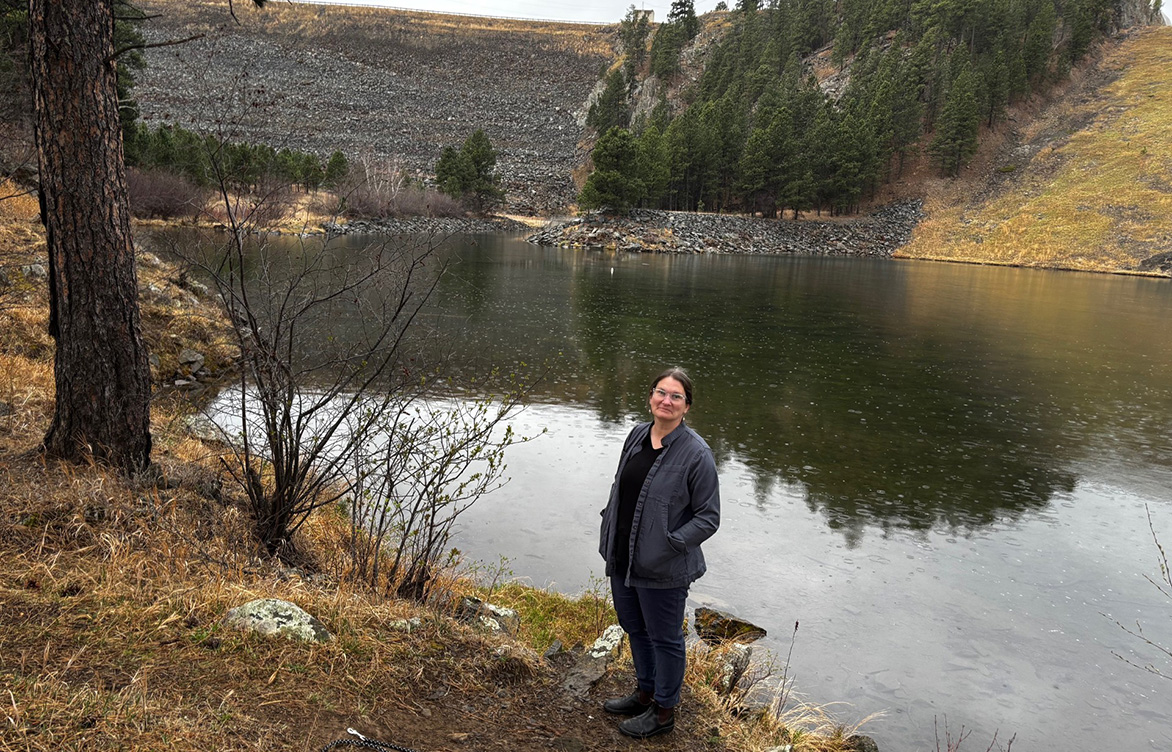
 Senior water resources engineer Susan Behery stands before the Pactola Dam during a rainy project site visit in South Dakota’s Black Hills, where changing precipitation patterns are making reservoir operations increasingly complex.
Susan Behery on bridging reservoir models and operations
Article summary: Reservoir operations in the western United States are becoming more complex as climate change and water supply uncertainty intensify. In this Q&A, senior water resources engineer Susan Behery draws on nearly two decades of experience, including work with the U.S. Bureau of Reclamation, to share how hydrologic forecasting, real-time monitoring, and RiverWare modeling can help water managers make smarter, more resilient decisions.
Reservoir operations in the western United States are becoming more complex by the year, shaped by shifting hydrology, competing demands, and growing uncertainty about what conditions will look like from one season to the next. For water managers, the challenge isn’t just forecasting supply: it’s making daily, sometimes urgent, decisions that balance risk, reliability, and long-term resilience.
For water managers, the challenge isn’t just forecasting supply: it’s making daily, sometimes urgent, decisions that balance risk, reliability, and long-term resilience.
For nearly two decades, Susan Behery has worked at the epicenter of those decisions. A senior water resources engineer who recently joined Barr from the U.S. Bureau of Reclamation, she has operated large federal reservoirs and supported reservoir operations, water-supply forecasting, and hydrologic modeling across the Colorado River Basin and beyond. Her work spans everything from long-term planning and scenario modeling to real-time operations and operational support for water managers.
Here, Susan shares her perspective on how reservoir systems are managed on the ground, how modeling best supports real-world decisions, and what it takes to prepare for a future in which climate patterns are increasingly difficult to predict.
It’s been about a year since you joined Barr after spending over a decade with the Bureau of Reclamation. What’s different about your current role in reservoir operations?
My career has been shaped by spending much of my life in the West, especially in Colorado and New Mexico, working on water supply, reservoir operations, and arid hydrology. I was deeply involved in reservoir operations at the Bureau of Reclamation for 13 years, and I’ve essentially continued that work, just in a different capacity. I’m still tracking snowpack and runoff, still developing and interpreting reservoir models, still supporting day-to-day operations. For me, a big advantage of being a consultant is that I can offer those same skills to represent and advocate for anyone’s water needs: not only irrigation districts and federal agencies, but also tribal governments, rural communities, and anyone who needs help.
Right now, you’re helping a reservoir operator manage water supply in real time. What does that look like?
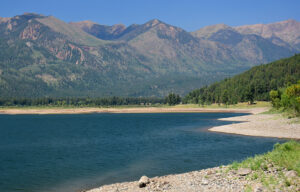
A lot of my work at Barr is very hands-on. I’m currently the on-call hydrologist for an irrigation district in southern Colorado, which means I’m involved in real-time decision-making. I’m continuously monitoring weather patterns, snowpack, runoff timing, and irrigation demand, and I’m helping the district balance these factors to determine how the reservoir should be operated. During the monsoon season, this work can become very fast-paced. I’m watching storm systems and stream gages, coordinating with the National Weather Service, and helping the district decide when to release water to avoid problems. Between storms, I work closely with state agencies to understand water-rights implications of operational decisions, with tribes to account for their storage shares, and with federal entities to align operations with safety plans for ongoing reservoir repairs.
What’s changing about water supply management in the West, and how are those changes affecting how reservoirs are operated?
What’s striking is how quickly climate patterns are changing and how extreme they’ve become. We’ve seen recent years with record-low snowpack, extremely warm winters, and then major storm events all within a short period. In one recent case, runoff timing shifted earlier by more than a month, which is huge. That completely changes how reservoirs are filled and managed because water managers are suddenly dealing with water arriving before it’s needed. Suddenly, they have to decide whether to release water early, knowing users might need it later. This unpredictability creates cascading challenges that must be managed in real time.
In an unpredictable climate, how can modeling and scenario planning help with those real-time decisions?
The goal of modeling should be preparation rather than prediction. … Preparation doesn’t eliminate risk, but it makes it more manageable.
A reservoir model is essential, but it’s not the end goal. Modeling tools like RiverWare let us simulate how reservoir systems behave under different conditions—different snowpack, demand levels, or operating rules. Modeling a range of scenarios helps us understand what might happen. But the goal of modeling should be preparation rather than prediction. When you’ve already explored a range of scenarios, even ones that seem unlikely, you can be less surprised when conditions shift. You have a sense of the potential consequences, which helps you react more effectively in real time. It also gives water managers a chance to consider the possibilities ahead—how a shorter water year might affect irrigation or how extreme weather could impact farming practices. That kind of preparation doesn’t eliminate risk, but it makes it more manageable.
How has your experience with the Bureau of Reclamation influenced the way you approach consulting?
One of the biggest things I brought with me is an understanding of how water management decisions rely on communication and transparency. At the Bureau of Reclamation, I worked with many water managers and water users who had very different priorities, and I saw firsthand how technical information was interpreted—or sometimes misunderstood—by different groups. I learned that effective management requires more than a model. It requires communicating results in terms of potential outcomes and tradeoffs of management options. If water managers and water users cannot understand or trust the implications of model outputs, they can’t make the best decisions.
What keeps you motivated, given these challenges?
For me, it’s the combination of the technical challenge and the impact. These aren’t abstract problems—my work affects whether people have water now and in the future. I’m especially interested in working with rural and underserved communities, where the challenges are often tied not just to water availability but also to limited water-supply infrastructure and fewer resources for long-term planning.
At Barr, I can lean on a deep, diverse, and collaborative bench of expertise—across hydrology, modeling, data science, and more. That wasn’t something I had in the same way before, and it’s changed how I work. I can be more responsive to my clients’ individual needs and develop stronger solutions. Having the breadth of expertise and teaming opportunities at Barr to support Western communities in a way that’s more dynamic and responsive than what I could accomplish in a federal role is meaningful to me, and it’s a big part of why I’m here.
For help preparing your water-supply operations for the future, contact our team.
Join Susan at the RiverWare User Group Meeting
Join us at the RiverWare User Group Meeting in Boulder, Colorado, August 26 and 27, 2026, at the University of Colorado Boulder’s William’s Village Community Center. Susan will present on Barr’s reservoir modeling and planning services supporting the West Dakota Water Development District’s Deerfield-Pactola reservoir system.
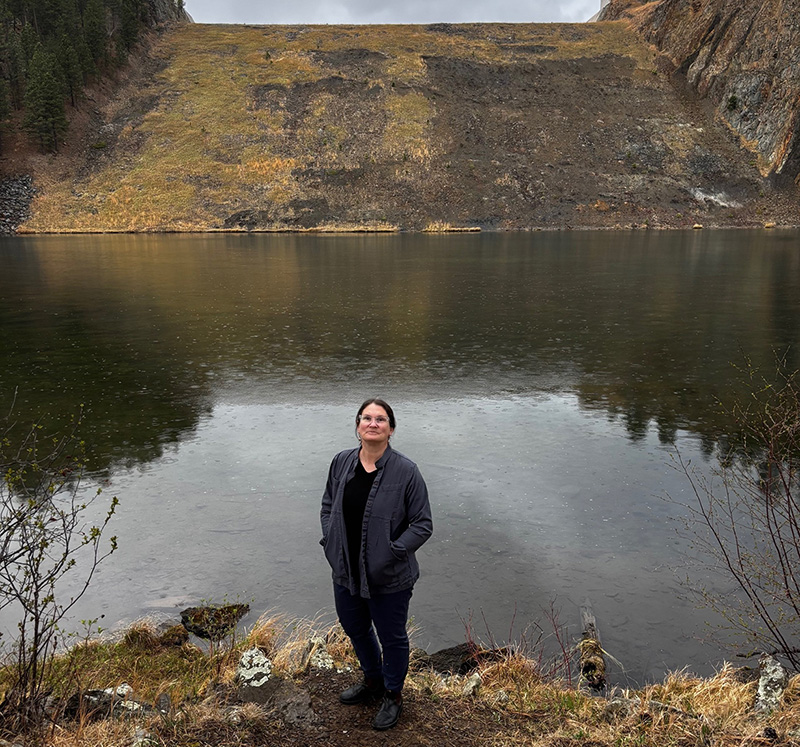
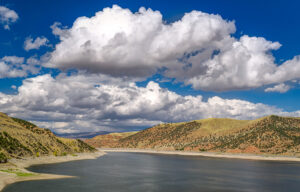
Pactola Reservoir is a cornerstone in South Dakota’s Rapid Valley water supply system, providing reliable water for agriculture, residents, businesses, and recreation. Susan is helping reservoir managers improve water supply reliability and watershed outcomes through scenario-based reservoir operations modeling.
About Susan Behery
Susan Behery is a senior water resources engineer in Barr’s Durango, Colorado, office with nearly 20 years of experience in reservoir operations, water-supply forecasting, hydrologic modeling, and water resources planning across the western U.S. Prior to joining Barr, she spent 13 years with the U.S. Bureau of Reclamation, where she supported reservoir operations and water management in the Colorado River and San Juan River basins. Today, she helps water managers, utilities, irrigation districts, and communities navigate uncertainty through scenario planning, forecasting, and real-time operational support.